
Everyone in Ireland has an opinion about the weather, and Met Éireann has the numbers behind it. This page brings together the official long-term averages for rain, temperature, sunshine, frost and wind, the records set in 2025 and 2026, and how Ireland’s climate compares with the rest of Europe. It is written for journalists, students, gardeners and anyone deciding how a building, a business or a garden needs to cope with Irish conditions. Each figure is labelled with the period it covers, and the long-term figures use the 30-year average for 1991 to 2020, which Met Éireann adopted as its standard reference in 2023.
Key weather statistics for Ireland at a glance
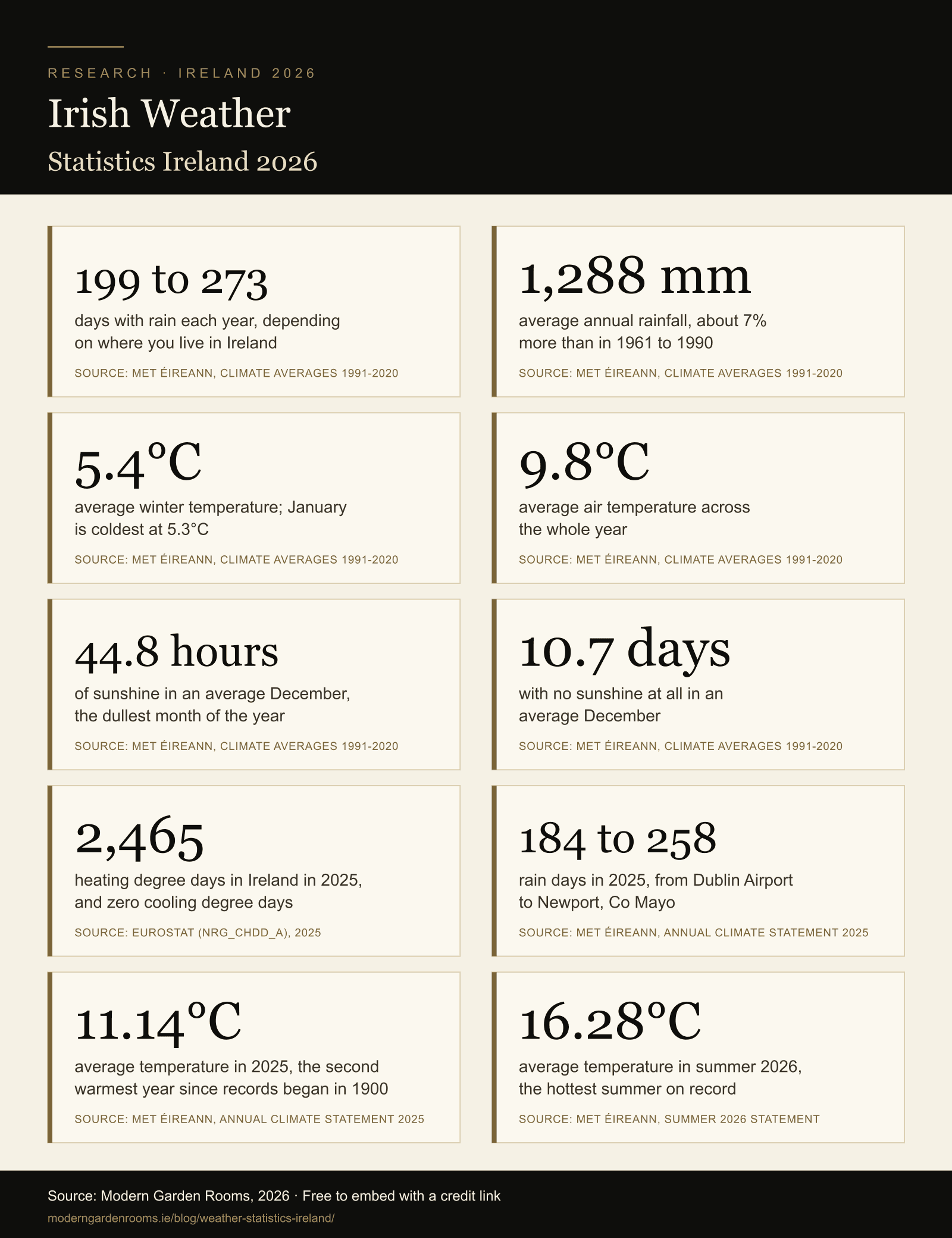
- Most places in Ireland get between 199 and 273 rain days a year, counting any day with at least 0.2 mm of rain. Source: Met Éireann, Ireland’s Climate Averages 1991-2020.
- Average annual rainfall is about 1,288 mm, roughly 7% more than in 1961 to 1990, and ranges from 878 mm on the east coast to 2,044 mm in the south-western mountains. Source: Met Éireann, Climate Averages 1991-2020.
- The average winter temperature is 5.4°C, and January is the coldest month at 5.3°C. Source: Met Éireann, Climate Averages 1991-2020.
- The average air temperature across the year is 9.8°C, about 0.7°C warmer than in 1961 to 1990. Source: Met Éireann, Climate Averages 1991-2020.
- December averages just 44.8 hours of sunshine and 10.7 days with no sunshine at all. Source: Met Éireann, Climate Averages 1991-2020.
- 2025 was the second warmest year on record in Ireland, at 11.14°C, and the four warmest years since 1900 are 2022 to 2025. Source: Met Éireann, Annual Climate Statement 2025.
- Rain fell on between 184 and 258 days in 2025, from Dublin Airport to Newport in Co Mayo. Source: Met Éireann, Annual Climate Statement 2025.
- Summer 2026 was the hottest on record, at an average of 16.28°C, beating the record set only a year earlier. Source: Met Éireann, Climate Statement for Summer 2026.
- Ireland recorded 2,465 heating degree days in 2025 and no cooling degree days, against 2,828 and 128 across the EU. Source: Eurostat, table nrg_chdd_a.
- Storm Éowyn produced a gust of 184 km/h at Mace Headin January 2025, the highest wind speed in Ireland’s digital climate record. Source: Met Éireann, Annual Climate Statement 2025.
Embed This Infographic
This infographic is free to use on your own site. Copy the code below and keep the credit link back to this page.
<a href="https://moderngardenrooms.ie/blog/weather-statistics-ireland/"><img src="https://moderngardenrooms.ie/images/blog/weather-statistics-ireland-infographic.png" alt="Weather Statistics Ireland 2026 infographic by Modern Garden Rooms" width="1200" height="1560" style="max-width:100%;height:auto;border:0;" /></a>
<p>Source: <a href="https://moderngardenrooms.ie/blog/weather-statistics-ireland/">Weather Statistics Ireland 2026</a> by Modern Garden Rooms</p>
How often it rains in Ireland
Met Éireann counts three kinds of rainy day. A rain day has at least 0.2 mm, a wet day at least 1 mm and a very wet day at least 10 mm. Over 1991 to 2020, the average number of rain days ranged from 199 to 273 a year, wet days from 146 to 228, and very wet days from 23 to 71. The numbers fall from west to east. The east and south-east see the fewest rain days and the elevated west and north-west the most.
Put another way, even the driest parts of the country see some rain on more than half the days of the year, and the wettest see it on three days in four. Both shares are calculated from the Met Éireann ranges, at 199 and 273 days out of 365.
Single years vary around those averages. In 2025, the number of rain days ranged from 184 at Dublin Airport to 258 at Newport, Co Mayo, and very wet days ranged from 20 at Phoenix Park and Dublin Airport to 66 at Valentia Observatory in Co Kerry. Winter is concentrated: in winter 2025/26 alone, rain fell on between 61 and 77 days of a 90-day season.
How much rain falls, and when
Nationally, annual average rainfall over 1991 to 2020 is approximately 1,288 mm, ranging from 878 mm along the east coast to 2,044 mm in the mountains of the south-west. Winter and autumn are the wettest seasons, with 380 mm and 369 mm on average. Spring is the driest, with 256 mm, followed by summer with 282 mm. December is the wettest month at about 142 mm, and April and May are the driest at 79 mm and 82 mm.
Ireland is getting wetter. Annual average rainfall rose by about 7% between the 1961 to 1990 and 1991 to 2020 periods, with the largest increases in the west and north. Summer rainfall rose the most, by 12%, followed by winter at 7%, autumn at 4% and spring at 3%. The number of rain days, wet days and very wet days also rose between the two periods.
Recent years have been wetter than the average. In 2025, national rainfall was 1,338.7 mm, 104% of the 1991 to 2020 average, making it the 15th wettest year since 1941, with annual totals ranging from 804.2 mm at Dublin Airport to 1,809.4 mm at Valentia Observatory. Winter 2025/26 brought 113% of the normal rainfall, and October 2026 brought 155.3 mm, 120% of the average.
Temperatures through the year
Ireland’s climate is mild, but its winters are long and cool. Over 1991 to 2020, the annual mean air temperature was 9.8°C, ranging from about 8.5°C on high ground to 10.8°C on the coast. Winter averaged 5.4°C, spring 8.8°C, summer 14.6°C and autumn 10.3°C. July was the warmest month at 15.2°C and January the coldest at 5.3°C.
| Season | Mean °C | Mean min °C | Mean max °C | Rainfall mm |
|---|---|---|---|---|
| Winter | 5.4 | 2.4 | 8.5 | 380 |
| Spring | 8.8 | 4.8 | 12.8 | 256 |
| Summer | 14.6 | 10.7 | 18.6 | 282 |
| Autumn | 10.3 | 6.8 | 13.7 | 369 |
Source: Met Éireann, Ireland’s Climate Averages 1991-2020, published 2023.
Nights are colder still. The average minimum temperature is 2.3°C in both January and February, and the average winter minimum is 2.4°C. Even in summer, the average minimum is only 10.7°C. The average maximum reaches 19.1°C in July but only 8.2°C in January, and the average daytime maximum across the whole winter is just 8.5°C.
Frost, snow and the coldest days
Every station in the country recorded frost in 2025. Days with ground frost ranged from 32 at Sherkin Island, Co Cork to 135 at Phoenix Park in Dublin, and days with air frost from one at a few coastal stations to 45 at Mount Dillon, Co Roscommon. The coldest air temperature of the year was -7.6°C at Athenry, Co Galway on 9 January, and the lowest grass minimum was -11.8°C at Mullingar. An Arctic airmass brought snow to the south and west in early January.
The first air frost of the 2026 autumn came on 17 October, during a short spell of high pressure.
Sunshine and dark winter months
Across Met Éireann’s twelve sunshine stations, the mean annual sunshine for 1991 to 2020 is 1,403.3 hours. Sherkin Island in Co Cork is the sunniest station with 1,541.9 hours, and Ballyshannon in Co Donegal the dullest with 1,252.3 hours. The east and south coasts are generally sunnier than the west and north. Annual sunshine rose by 4.5%, or 58.6 hours, compared with 1961 to 1990.
The seasonal contrast is stark. May is the sunniest month with 191.4 hours on average, followed by June with 173.5 hours. December is the dullest, with only 44.8 hours, or about an hour and a half a day when calculated across its 31 days. December also has the most days with no sunshine at all, at 10.7, against just 2.2 in May. In 2025, a very sunny year, totals ranged from 1,348.0 hours at Valentia Observatory to 1,721.4 hours at Johnstown Castle, Co Wexford.
Wind and storms
Ireland is windy as well as wet. The annual mean hourly wind speed ranges from 9 knots at Shannon Airport to 15 knots at Malin Head, and the strongest winds come in winter, when they average up to 18 knots at Malin Head. Five named storms directly affected Ireland in 2025. During Storm Éowyn on 24 January, Mace Head in Co Galway recorded a gust of 184 km/h and a 10-minute mean wind of 142 km/h, the highest wind speeds in Ireland’s digital climate record. October 2026 brought the first two named storms of the 2026/27 season, Storm Austen and Storm Boelo.
A warming climate: 2025 and 2026 in the record books
The averages are shifting. The 1991 to 2020 annual mean temperature is about 0.7°C higher than the 1961 to 1990 average, with every month warmer and the largest increase, 1°C, in May. Spring warmed most, by about 0.8°C, and winter least, by 0.6°C.
The last four years have been the four warmest on record. The average annual temperature in 2025 was 11.14°C, 1.59°C above the 1961 to 1990 average, only slightly behind the record of 11.20°C set in 2023, the first year in which the national mean passed 11°C. Seven of the ten warmest years have occurred since 2005, and none of the ten coldest since 2000. The coldest year on record remains 1919, at 8.73°C.
2026 has continued the run. Summer 2026 averaged 16.28°C, the hottest summer since records began in 1900, beating the previous record of 16.19°C set in 2025 and running 2.03°C above the 1961 to 1990 average. July 2026 was one of the hottest, driest and sunniest months on record, and a partial drought at Oak Park in Co Carlow lasted 66 days, the longest since 1941. Winter 2025/26 averaged 6.58°C, the 20th mildest since 1900, and by October 2026 Ireland had recorded nine consecutive months above the 1991 to 2020 average.
Heating and cooling: Ireland compared with Europe
Eurostat measures how much heating and cooling a country’s weather calls for, using degree days. Under its published method, heating degree days are counted on days when the mean temperature is 15°C or lower, and cooling degree days on days when it is 24°C or higher. In 2025, Ireland recorded 2,465 heating degree days and no cooling degree days. The EU as a whole recorded 2,828 heating degree days and 128 cooling degree days.
Ireland’s heating need is about 13% below the EU average, because its winters are mild, a figure calculated from the two Eurostat totals. What sets it apart is the other number. Ireland has recorded effectively no cooling degree days in any year since 2015, so its buildings almost never need cooling but need heating for much of the year.
How these statistics were compiled
This page draws on Met Éireann’s Ireland’s Climate Averages 1991-2020, published in 2023, its Annual Climate Statement for 2025, its climate statements for winter 2025/26, summer 2026 and October 2026, its Climate of Ireland 2023 summary, and Eurostat’s degree day table, which was last updated in May 2026. Every source was opened and every figure checked on 19 November 2026. Figures described as calculated were worked out from the cited sources and are not published by them: the shares of days with rain, the daily average sunshine in December, the six-month pattern of maximum temperatures, and the gap between Irish and EU heating degree days.
Two limitations apply. The 2025 and 2026 figures are provisional and may be revised by Met Éireann. The sunshine averages are based on twelve stations, and the days without sunshine on eight, so they describe those places rather than every part of the country.
The page will be updated when Met Éireann publishes its Annual Climate Statement for 2026 in early January 2027 and when Eurostat releases degree days for 2026. The year in the title identifies when the page was last compiled. It does not mean every statistic was measured in 2026.
How Modern Garden Rooms helps
The numbers above are the brief for any building at the end of an Irish garden. It has to stay dry through up to 273 days of rain, warm through winters that average 5.4°C, and bright enough to use in a December with less than 45 hours of sun. It almost never has to stay cool.
Modern Garden Rooms builds fully insulated garden rooms across Dublin and Leinster, insulated in the floor, walls and roof so they can be used every day of the year. The same build is behind our golf simulator rooms, which keep the game going through the dark months, and our garden gym rooms. A free site visit will confirm what your garden allows.
