
Anyone pricing a building job in Ireland, from a garden room to a housing scheme, is working against three moving numbers: what materials cost, what labour costs, and what contractors are charging. This page brings the official measures of all three together, with the cost of delivering and rebuilding a home and the level of activity in the sector, for journalists, surveyors, self-builders and homeowners comparing quotes. Each figure is labelled with the period it measures and the body that published it.
Key construction cost statistics for Ireland at a glance
- Wholesale prices for construction materials rose by 3.3% in the 12 months to August 2026 and were unchanged in the month. Source: CSO, Wholesale Price Index August 2026.
- The all-materials index stood at 131.1 in August 2026, against a 2021 base of 100, so materials cost 31% more than the 2021 average. Source: CSO, table WPM39.
- Ready mixed mortar and concrete rose 7.6% in the year to August 2026, while cement fell 7.8%. Source: CSO, table WPM39.
- Average weekly earnings in construction were €1,089.21 in the second quarter of 2026, up 21% in three years, the largest rise of any sector. Source: CSO, Earnings and Labour Costs Q2 2026.
- Commercial tender prices rose 3% in the first half of 2026, three times the rate of the previous six months, and 4% over 12 months. Source: SCSI, Tender Price Index August 2026.
- House rebuilding costs rose 7% nationally in the year to November 2025, and a three-bed semi in Dublin costs €3,381 per square metre to rebuild. Source: SCSI, House Rebuild Calculator release, November 2025.
- Delivering a three-bed semi in the Greater Dublin Area cost €461,000 in 2023, up 24% since 2020, with hard construction costs making up 53% of delivery cost nationally. Source: SCSI, The Real Cost of New Housing Delivery 2023.
- 188,600 people were employed in construction in the second quarter of 2026, compared with 119,200 ten years earlier. Source: CSO, Labour Force Survey table QLF03.
- Residential building output rose 12.6% in a year to the second quarter of 2026 while non-residential building fell 18%. Source: CSO, Production in Building and Construction Index Q2 2026.
- 32,581 new homes were commenced in the 12 months to September 2026, including 3,682 in September. Source: Department of Housing, September Commencements 2026.
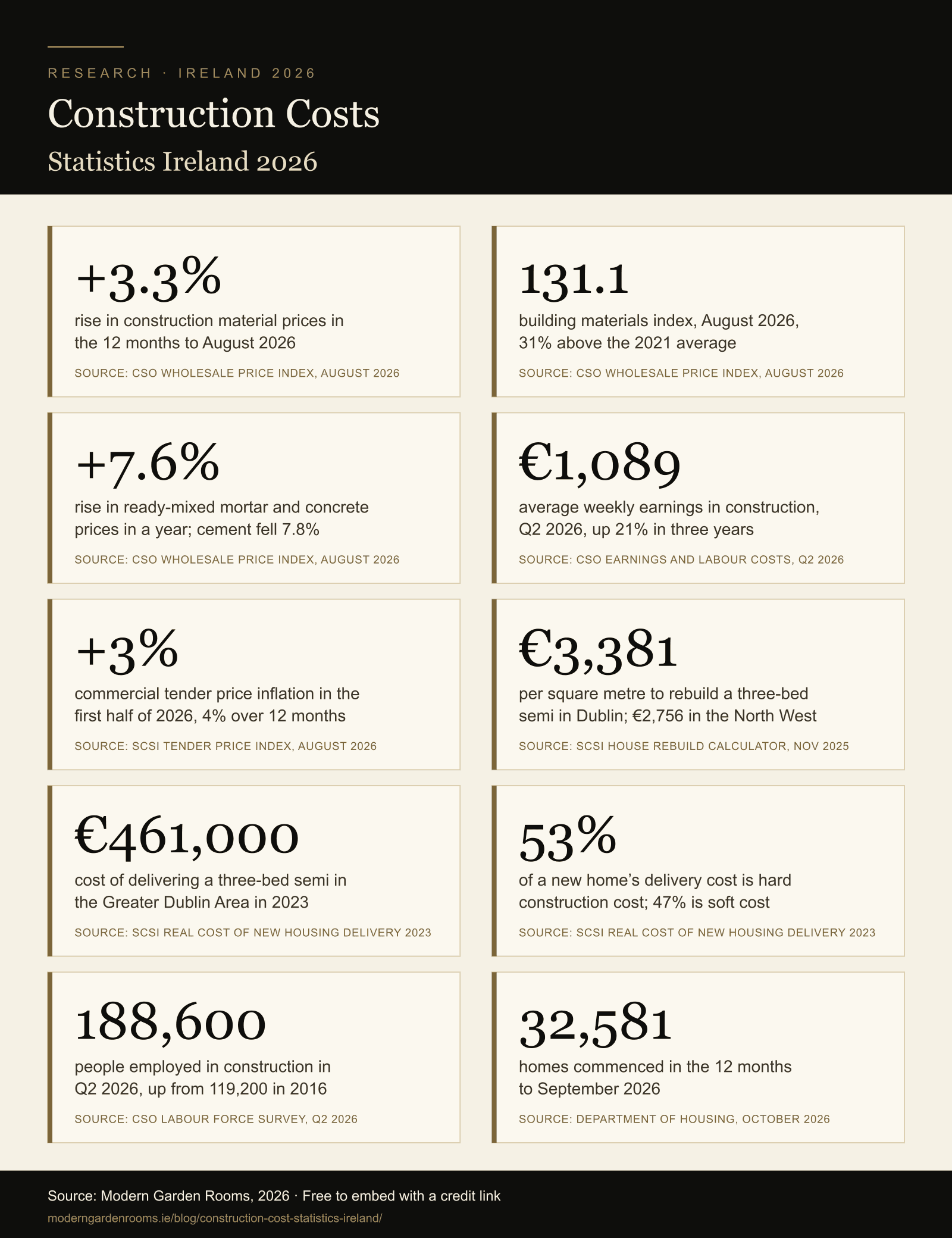
Embed This Infographic
This infographic is free to use on your own site. Copy the code below and keep the credit link back to this page.
<a href="https://moderngardenrooms.ie/blog/construction-cost-statistics-ireland/"><img src="https://moderngardenrooms.ie/images/blog/construction-cost-statistics-ireland-infographic.png" alt="Construction Cost Statistics Ireland 2026 infographic by Modern Garden Rooms" width="1200" height="1560" style="max-width:100%;height:auto;border:0;" /></a>
<p>Source: <a href="https://moderngardenrooms.ie/blog/construction-cost-statistics-ireland/">Construction Cost Statistics Ireland 2026</a> by Modern Garden Rooms</p>
Building material prices
The CSO measures what builders pay for materials every month in its Wholesale Price Index. In August 2026, wholesale prices for construction products were unchanged in the month but rose by 3.3% in the 12 months since August 2025. The all-materials index, which excludes VAT, stood at 131.1 against a base of 100 in 2021, so a basket of building materials that cost €100 in 2021 cost about €131 in August 2026. The 31% figure is calculated from the index level published in CSO table WPM39.
The average hides very different movements. Bituminous macadam and asphalt rose 16.1% in the year, reinforcing metal 10.8%, paints 9.2% and ready mixed mortar and concrete 7.6%. Stone, sand and gravel rose 5.2% and concrete blocks and bricks 4.1%. At the other end, cement fell 7.8%, lighting equipment 3.3% and electrical fittings 1.3%, and insulating materials rose by only 1.3%. The table below lists the main items.
| Material | Change |
|---|---|
| Bituminous macadam and asphalt | +16.1% |
| Reinforcing metal | +10.8% |
| Paints, oils and varnishes | +9.2% |
| Ready mixed mortar and concrete | +7.6% |
| Stone | +5.7% |
| PVC pipes and fittings | +5.4% |
| Concrete blocks and bricks | +4.1% |
| Glass | +4.0% |
| Wooden windows and doors | +2.7% |
| Rough timber (softwood) | +2.7% |
| Insulating materials | +1.3% |
| Plaster | +0.5% |
| Electrical fittings | -1.3% |
| Lighting equipment | -3.3% |
| Cement | -7.8% |
Source: CSO, table WPM39, Wholesale Price Index excluding VAT for building and construction materials, extracted 27 October 2026.
Construction wages and labour costs
Labour has been rising faster than materials. The CSO’s preliminary estimate puts average weekly earnings in construction at €1,089.21 in the second quarter of 2026, up from €1,044.48 a year earlier and €900.39 in the second quarter of 2023. The one-year increase of 4.3% and the three-year increase of 21.0% are calculated from those figures, and the CSO reports the three-year rise as the largest of any sector. Average hourly earnings in construction were €29.88, and the average construction employee was paid for 36.5 hours a week.
What an employer pays is higher again. Average hourly total labour costs in construction, which add employer social insurance and pension contributions to earnings, were €34.61 in the second quarter of 2026, up from €28.27 three years earlier. The CSO puts that three-year increase at 22.4%, again the largest of any sector. Across the whole economy, average weekly earnings were €1,046.88 in the same quarter, so construction earnings were about 4% above the national average, a comparison calculated from the two CSO figures. Consumer prices rose 3.6% over the year.
The workforce has grown but is no longer growing. The Labour Force Survey recorded 188,600 people employed in construction in the second quarter of 2026, down 1,700 on the 190,300 recorded a year earlier, and up from 119,200 in the second quarter of 2016. The ten-year increase of 58% is calculated from the two counts. Surveyors told the SCSI in August 2026 that skilled labour remains in short supply, and a Sectoral Employment Order raised construction wage rates from August 2026.
Tender prices: what contractors are charging
The Society of Chartered Surveyors Ireland tracks the prices contractors tender for commercial projects. Its August 2026 index found that commercial tender prices increased by 3% in the first half of 2026, a trebling of the 1% rate recorded in the previous six months, and that the annual median rate of inflation for the past 12 months was 4%. Munster recorded the highest regional rate at 3.3%, followed by Connacht and Ulster at 3% and Dublin at 2.5%, which returned to inflation after a flat second half of 2025. Approximately 84% of chartered quantity surveyors placed the market in an upswing or at its peak.
The longer run shows how far inflation has eased. The February 2026 index put the annual rate for 2025 at 2.5% nationally, the lowest since 2.2% in 2020, down from 3% in 2024 and from a record 11.5% in 2022, when the first half of that year alone recorded 7.5%. The SCSI notes that its index covers commercial new-build projects and should not be applied directly to residential work or smaller jobs, where labour makes up a larger share of the cost.
Regional differences persist over the longer period too. For 2025 as a whole the SCSI recorded annual tender inflation of 3.8% in Connacht and Ulster and 3.5% in Munster, against 1% in Dublin and 0.5% in the rest of Leinster, and 69% of surveyors expected prices to rise again in the first half of 2026. By August 2026 the 12-month rate had reached 4.8% in both Munster and Connacht and Ulster, so the regions with the most new housing activity are also the ones where contractors’ prices are rising fastest.
What it costs to build a home
The most detailed public costing of a new home is the SCSI’s Real Cost of New Housing Delivery, published in December 2023 and based on 114 square metre three-bed semi-detached houses in privately built schemes. It found that the average cost of delivering a three-bed semi in the Greater Dublin Area was €461,000, an increase of over €90,000 or 24% on the 2020 figure of €371,000. Nationally the average was €397,000, and €386,000 outside Dublin.
Only about half of that is construction. Hard costs, meaning materials and the building work itself, made up 53% of delivery cost nationally and 49% in the Greater Dublin Area, where soft costs such as land, levies, finance, professional fees, VAT and margin made up 51%. Hard costs ranged from just over €198,000 per house in the North West to just over €228,000 in the Greater Dublin Area, and soft costs from about €156,000 to just over €233,000. Land and acquisition averaged 13% of delivery cost. Dividing the Greater Dublin hard cost by the 114 square metre floor area gives about €2,000 per square metre for the building work alone, a figure calculated from the SCSI report and not published by it.
What it costs to rebuild a home
The SCSI also publishes the minimum cost of rebuilding a standard house for insurance purposes. Its November 2025 release found that house rebuilding costs increased by an average of 7% nationally over the previous 12 months, up from 6% the year before and down from 12% in 2023. Dublin rose 5% and has the highest costs, Cork rose 3%, Galway and Limerick 7%, Waterford and the North East 8%, and the North West 9%, the largest rise from the lowest base.
The release gives two worked examples. In Dublin a typical three-bed semi of 98 square metres costs a minimum of €331,340 to rebuild, at €3,381 per square metre. In the North West the same house costs €270,090, at €2,756 per square metre, a difference of €61,250. These rates include demolition, professional fees and VAT at 13.5% on building work, which is why they sit well above the hard cost of a new scheme house. The SCSI attributes the gap between regions mainly to competition for builders and tradespeople, and notes that new landfill and recovery levies have added to demolition costs.
How busy the sector is
Output is shifting towards housing. The CSO’s production index shows that the volume of production in residential building rose 12.6% between the second quarter of 2025 and the second quarter of 2026, while non-residential building fell 18.0% and civil engineering fell 4.4%. Across all construction the volume of production was 3.4% lower than a year earlier, although it rose 0.4% on the quarter.
The housing pipeline is full. The Department of Housing recorded 3,682 commencement notices for new homes in September 2026 and 32,581 on a rolling 12-month basis, led by Dublin City with 1,247 units, Fingal with 390 and Meath with 272. Behind those starts, the CSO counted 36,284 new dwelling completions in 2025, the most since its series began in 2011, and 34,974 homes granted planning permission in the same year, as set out in our planning permission statistics for Ireland.
How these statistics were compiled
This page draws on the CSO’s Wholesale Price Index, Earnings and Labour Costs, Labour Force Survey and Production in Building and Construction releases, three Society of Chartered Surveyors Ireland publications, and the Department of Housing’s monthly commencement notices. The material and earnings figures were taken directly from CSO tables WPM39, EHQ03 and QLF03 through the CSO’s open data service. Every source was opened and every figure checked on 27 October 2026. Figures described as calculated were worked out from the cited source and are not published by it: the 31% rise in the materials index since 2021, the one-year and three-year changes in construction earnings, the construction premium over average earnings, the ten-year change in construction employment, and the hard cost per square metre of a Greater Dublin scheme house.
Two limitations apply. The SCSI tender price index measures commercial projects and the SCSI rebuild rates include fees and VAT, so neither is a direct price for a domestic build. The CSO earnings figures for the second quarter of 2026 are preliminary and may be revised in the next release.
The page will be updated when the CSO publishes the September 2026 Wholesale Price Index in late October, when the SCSI publishes its next rebuild cost guide in November 2026 and its next tender price index in February 2027, and when final earnings figures for the third quarter of 2026 appear. The year in the title identifies when the page was last compiled. It does not mean every statistic was measured in 2026.
How Modern Garden Rooms helps
The figures above are why no builder can hold a price indefinitely. Materials are 31% dearer than in 2021, construction wages are up 21% in three years, and the hard cost of a scheme house in Dublin works out at about €2,000 per square metre before land, fees and VAT.
Modern Garden Rooms prices every garden room from a published guide rate of €2,000 per m² plus VAT for a fully insulated, finished room, and our garden room cost guide sets out starting prices by size and what moves them. A free site visit produces a written quote for your garden, and most rooms fall within the 30 square metre planning exemption explained in our planning permission guide.
