
Planning permission figures are quoted in almost every Irish housing story, but they are scattered across the Central Statistics Office, the Office of the Planning Regulator, An Coimisiún Pleanála and the Statute Book. This page brings the current numbers together for journalists, researchers and homeowners: how many homes and extensions are approved, how often applications are granted, how appeals go, what an application costs, and what stopped needing permission in July 2026. Each figure is labelled with the period it measures.
Key planning permission statistics for Ireland at a glance
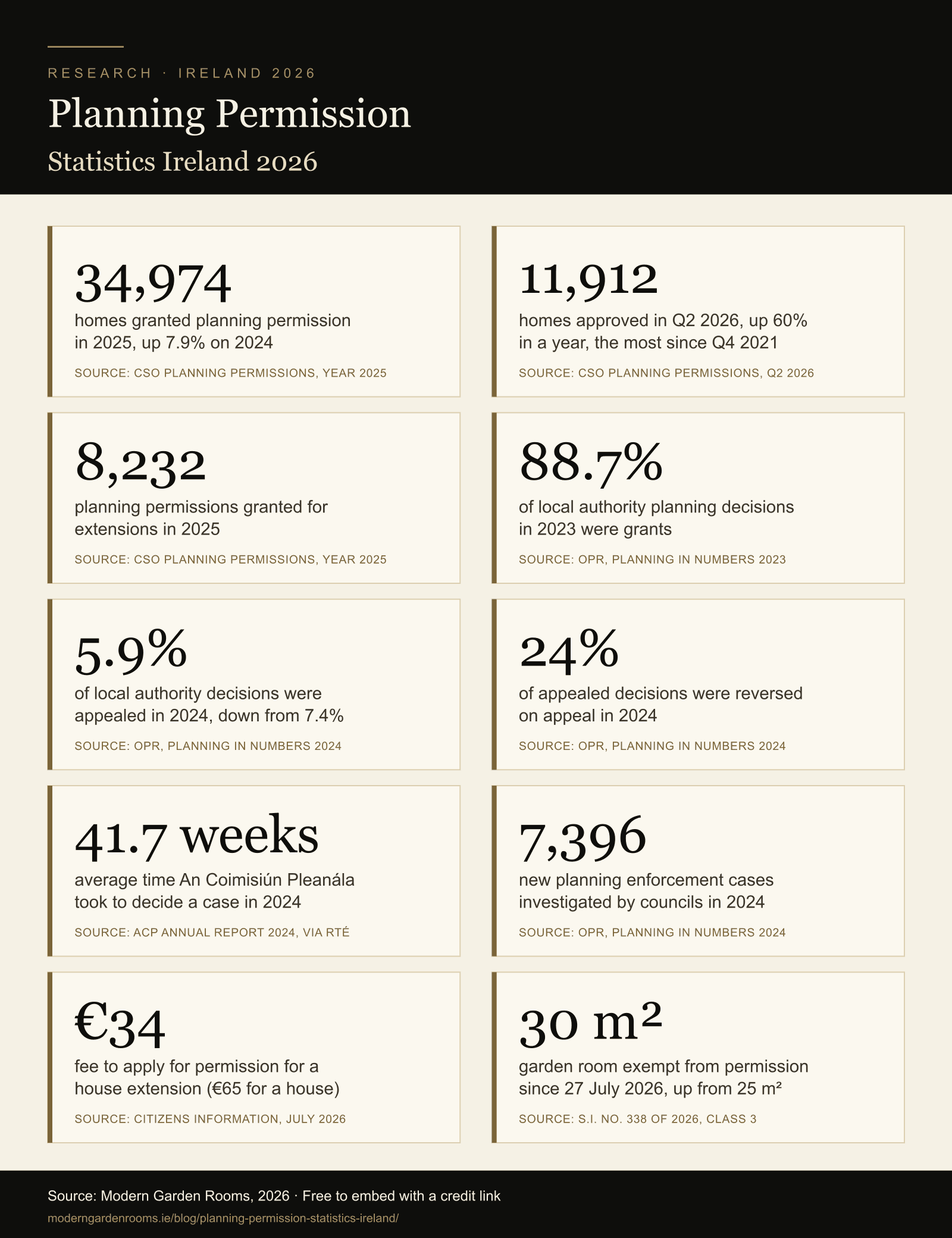
- 34,974 homes were granted planning permission in 2025, an increase of 7.9% on the 32,401 approved in 2024. Source: CSO, Planning Permissions Quarter 4 and Year 2025.
- 11,912 homes were approved in the second quarter of 2026, up 60% in a year and the highest quarterly total since the end of 2021. Source: CSO, Planning Permissions Quarter 2 2026.
- Planning authorities granted 29,574 individual permissions in 2025, of which 8,232 were for extensions. Source: CSO, Planning Permissions Quarter 4 and Year 2025.
- 20,615 houses were approved in 2025, the highest annual number since 2009. Source: CSO, Planning Permissions Quarter 4 and Year 2025.
- The national grant rate for planning applications was 88.7% in 2023, the latest year with complete local authority data. Source: Office of the Planning Regulator, Planning in Numbers 2023.
- 5.9% of local authority decisions were appealed in 2024, down from 7.4% in 2023, and 24% of appealed decisions were reversed. Source: Office of the Planning Regulator, Planning in Numbers 2024.
- An Coimisiún Pleanála took an average of 41.7 weeks to decide a planning case in 2024. Source: An Coimisiún Pleanála annual report, as reported by RTÉ in October 2025.
- Local authorities opened 7,396 new planning enforcement cases in 2024, up from 6,783 the year before. Source: Office of the Planning Regulator, Planning in Numbers 2024.
- The application fee is €34 for a house extension and €65 for a house, and a decision is normally due within 8 weeks. Source: Citizens Information, July 2026.
- Since 27 July 2026, the exempt size for a garden room or shed is 30 square metres, up from 25, and for a rear extension it is 45 square metres, up from 40. Source: S.I. No. 338 of 2026.
Embed This Infographic
This infographic is free to use on your own site. Copy the code below and keep the credit link back to this page.
<a href="https://moderngardenrooms.ie/blog/planning-permission-statistics-ireland/"><img src="https://moderngardenrooms.ie/images/blog/planning-permission-statistics-ireland-infographic.png" alt="Planning Permission Statistics Ireland 2026 infographic by Modern Garden Rooms" width="1200" height="1560" style="max-width:100%;height:auto;border:0;" /></a>
<p>Source: <a href="https://moderngardenrooms.ie/blog/planning-permission-statistics-ireland/">Planning Permission Statistics Ireland 2026</a> by Modern Garden Rooms</p>
Almost 35,000 homes were granted permission in 2025
The CSO counts every dwelling unit that receives planning permission from a local authority or from An Coimisiún Pleanála. In 2025 the total was 34,974 units, up 7.9% from 32,401 in 2024. That recovery followed a fall of 21.4% in 2024, so the 2025 figure is still well below the level recorded two years earlier.
Houses led the increase. There were 20,615 houses approved in 2025, which the CSO describes as the highest number since 26,814 were approved in 2009. Apartments accounted for 14,359 units, or 41% of the total, and rose by 8.8%. One-off houses, the category that covers most self-builds, came to 5,095 units. One-off houses therefore made up 14.6% of all homes approved in 2025, a share calculated from the CSO table below.
| Type | 2024 | 2025 | Change |
|---|---|---|---|
| Multi-development houses | 14,301 | 15,520 | +8.5% |
| One-off houses | 4,906 | 5,095 | +3.9% |
| All houses | 19,207 | 20,615 | +7.3% |
| Apartments | 13,194 | 14,359 | +8.8% |
| Total dwellings | 32,401 | 34,974 | +7.9% |
Source: CSO, Planning Permissions Quarter 4 and Year 2025, published 12 March 2026.
The latest quarter was the strongest since 2021
The most recent release covers April to June 2026. In that quarter, 11,912 dwelling units were granted planning permission, compared with 7,447 in the same quarter of 2025. The increase of 60% produced the highest quarterly figure since the 13,450 units approved in the fourth quarter of 2021. It followed an annual decline of 1.0% in the first quarter of 2026.
Apartments drove the change. The number of apartments approved rose by 107% to 5,637, while houses rose by 33% to 6,275. Houses accounted for 53% of units approved in the quarter and apartments for 47%. Multi-development houses increased by 41.5% to 5,046, and one-off houses by 6.2% to 1,229. Units approved under the Strategic Housing Development process rose from 2,465 to 6,345.
A single quarter should be read with caution. The CSO attaches an advisory note to every release, warning that approvals can vary significantly from quarter to quarter when a few large schemes are decided together, and that a backlog of Strategic Housing Development cases may still be affecting the numbers.
Extensions, alterations and one-off houses
Most planning permissions are not for housing estates. Of the 29,574 permissions granted for all developments in 2025, 6,622 were for new dwellings, 9,251 were for other new construction, 8,232 were for extensions and 5,469 were for alterations and conversions. Extensions therefore made up 27.8% of all permissions granted, and extensions together with alterations and conversions made up 46.3%. Both shares are calculated from the CSO counts. The extension figure works out at about 158 permissions a week.
The same pattern holds in 2026. In the second quarter, 8,202 permissions were granted, an annual increase of 16.2%. Of those, 2,148 were for extensions, up 2.5%, and 1,776 were for alterations and conversions, up 34.4%. Permissions relating to dwellings accounted for 59.3% of the total, or 4,860 permissions, and 1,875 of those were for extensions to homes.
These counts cover only work that needed permission. Rear extensions, garden rooms and sheds under the exempt size limits never enter the statistics, and those limits were raised in July 2026. The extension figures for the second half of 2026 and for 2027 will show whether the higher thresholds reduce the number of household applications.
Where permissions are granted
Dublin dominates apartment approvals. The four Dublin local authorities approved 7,366 apartments in 2025, or 51% of the national total, followed by Cork with 2,191 and Meath with 772. Houses were spread more widely. Cork had the largest number of houses approved in 2025 with 3,132, followed by Dublin with 1,986 and Wicklow with 1,764.
In the second quarter of 2026 Dublin and Cork were almost level. Dublin recorded 3,241 units, an annual increase of 78.5%, and Cork recorded 3,234. Dublin accounted for 27% of all units approved in the quarter. The Midlands region of Laois, Longford, Offaly and Westmeath had the lowest totals, with 257 houses and 65 apartments.
How often planning permission is granted
The Office of the Planning Regulator compiles grant and refusal rates from local authority returns. In 2023 there were 30,578 valid planning applications, which was 1,793 fewer than in 2022. Planning authorities granted 24,448 applications and refused 3,113. The national grant rate was 88.7%, and it stayed between 87.4% and 89.2% in each of the five years to 2023. The refusal share of 11.3% is calculated from the granted and refused counts.
The national rate hides large local differences. In 2023 the grant rate ranged from 78.5% in Galway County to 97.3% in Leitrim. The share of applications rejected as invalid before assessment ranged from 8.2% in South Dublin to 36.2% in Carlow. An invalid application is one that does not meet the preliminary requirements, such as a correct site notice or the right fee.
There is an important gap in this series. The Department of Housing states that publication of its 2024 and 2025 planning application datasets has been paused while it works with local authorities on data collection. The regulator’s 2024 review notes that several key datasets on planning applications were unavailable. National grant and refusal rates for 2024 and 2025 have therefore not been published at the time of writing, and 2023 remains the latest year.
Appeals, reversals and waiting times
Appeals are less common than public debate suggests. The rate of local authority decisions appealed to An Coimisiún Pleanála fell from 7.4% in 2023 to 5.9% in 2024. Appeal rates ranged from 1.8% in Monaghan to 14.6% in Galway City. There were 2,035 appeals in 2023, according to the regulator’s 2023 review, and the number fell again in 2024.
When a decision is appealed, the original outcome usually stands. The reversal rate on appeal was 22.4% in 2023, its lowest level in five years, and rose to 24% in 2024. Roughly three out of four appealed decisions were therefore not reversed.
Time is the larger cost. An Coimisiún Pleanála, formerly An Bord Pleanála, took an average of 41.7 weeks to decide all planning cases in 2024, according to its annual report as covered by RTÉ. It decided 25% of cases within statutory timelines, compared with 28% a year earlier, while handling 12.8% more cases and reducing its open caseload by 38%. The commission said that 50% of cases were being decided within statutory timelines during 2025. It publishes quarterly casework statistics for readers who need the latest position.
Enforcement and legal challenges
Building without permission carries real risk. Local authorities investigated 7,396 new planning enforcement cases in 2024, up from 6,783 in 2023, and closed 6,349 investigations. The increase of 613 cases, or 9.0%, is calculated from those two figures. The most common reason for closing a case was that it was dismissed.
Court challenges have grown faster. Judicial review cases taken against An Coimisiún Pleanála rose from 86 in 2023 to 143 in 2024, which is an increase of 66% calculated from the regulator’s figures.
What an application costs and how long it takes
Fees for household applications are low. The fee to apply for permission to build a house is €65, and the fee for a house extension or a garage conversion is €34. Anyone can make a submission on an application for €20. The site notice must stay up for at least 5 weeks, the local authority must generally decide within 8 weeks, and there are 4 weeks after the decision in which to appeal. Permission normally lasts for 5 years.
Those fees cover a small part of the cost of the service. The operating cost of the planning functions of the 31 local authorities was €186.2 million in 2023, while income from planning fees was €28.3 million. Fee income therefore covered 15% of the cost, the lowest share in the six years reviewed by the regulator.
Permissions compared with homes built
A permission is not a home. It can lapse, be revised or wait years for funding. In 2025 the two measures were unusually close: 34,974 homes were approved and 36,284 homes were completed, which was the highest number of completions since the CSO series began in 2011. The housing pressures behind those numbers are set out in our statistics on adults living with their parents in Ireland.
Both figures sit below the rate the Government has set for itself. Its housing plan for 2025 to 2030 targets the construction of 300,000 homes, which averages 50,000 a year across the six years when calculated evenly. Approvals in 2025 were about 15,000 short of that annual average.
What no longer needs permission: the 2026 exemptions in numbers
Three sets of regulations came into operation on 27 July 2026, after a public consultation that received almost 1,000 submissions. The first, S.I. No. 338 of 2026, raised two long-standing limits. A rear extension is now exempt up to 45 square metres, where the limit had been 40. A garden room, shed or similar structure is exempt up to 30 square metres in total, where the limit had been 25. In both cases at least 25 square metres of private open space must remain, and the height limits of 4 metres with a pitched roof and 3 metres otherwise are unchanged.
The second, S.I. No. 339 of 2026, allows a house to be subdivided into no more than two units of at least 32 square metres each. The third, S.I. No. 340 of 2026, allows a detached home of 32 to 45 square metres in the rear garden of a house, subject to 20 conditions. The subdivision and garden home exemptions both require the owner to notify the planning authority at least 14 days before work starts, and both apply only to work commenced and completed by 31 December 2030.
These changes will produce a new data series. Each planning authority must keep a record of the notifications it receives and report the number to the Minister every year. The first annual returns should show how many garden homes and subdivisions were started, and a review of the exemptions is due 18 months after they came into operation. Building Regulations continue to apply in full to every exempt structure.
How these statistics were compiled
This page draws on two CSO Planning Permissions releases, the Office of the Planning Regulator’s Planning in Numbers reviews for 2023 and 2024, the Department of Housing, Citizens Information and the Irish Statute Book. Every source was opened and every figure checked on 30 September 2026. Figures described as calculated were worked out from the cited source and are not published by it: the shares of permissions for extensions and one-off houses, the weekly extension figure, the refusal share, the changes in enforcement and judicial review cases, and the annual average implied by the housing target.
Two limitations apply. The appeal timing figures come from An Coimisiún Pleanála’s 2024 annual report as reported by RTÉ, because the commission publishes its statistics as image files that cannot be quoted directly. The regulator’s 2024 review gives 32,491 homes approved in 2024, while the CSO’s current figure is 32,401 after revision. The CSO figure is used here.
The page will be updated when the CSO publishes its third quarter 2026 release, when the full year 2026 figures appear in March 2027, and when the Department of Housing resumes its annual application statistics. The year in the title identifies when the page was last compiled. It does not mean every statistic was measured in 2026.
How Modern Garden Rooms helps
For most homeowners the useful number on this page is the size limit. A garden room of up to 30 square metres, or a self-contained garden home of 32 to 45 square metres, can now be built behind many houses without a planning application, provided the conditions are met.
Modern Garden Rooms designs and builds both across Dublin and Leinster. Our guide to garden room planning permission explains the conditions in plain English and includes an eligibility checker, and our 45 square metre garden homes page covers the new dwelling exemption. A free site visit will confirm what your garden allows before any commitment is made.
