
Ireland measures exercise in three different ways. The CSO asks whether people took part in any sport or physical exercise at all, Sport Ireland asks whether they did so in the past week, and the Healthy Ireland Survey asks whether they reached the national guideline of 150 minutes of moderate activity. The three answers are very different, and this page sets them side by side with their sources so that journalists, researchers, gym operators and anyone planning a home gym can quote the right one. Each figure is labelled with the period it measures.
Key exercise and gym statistics for Ireland at a glance
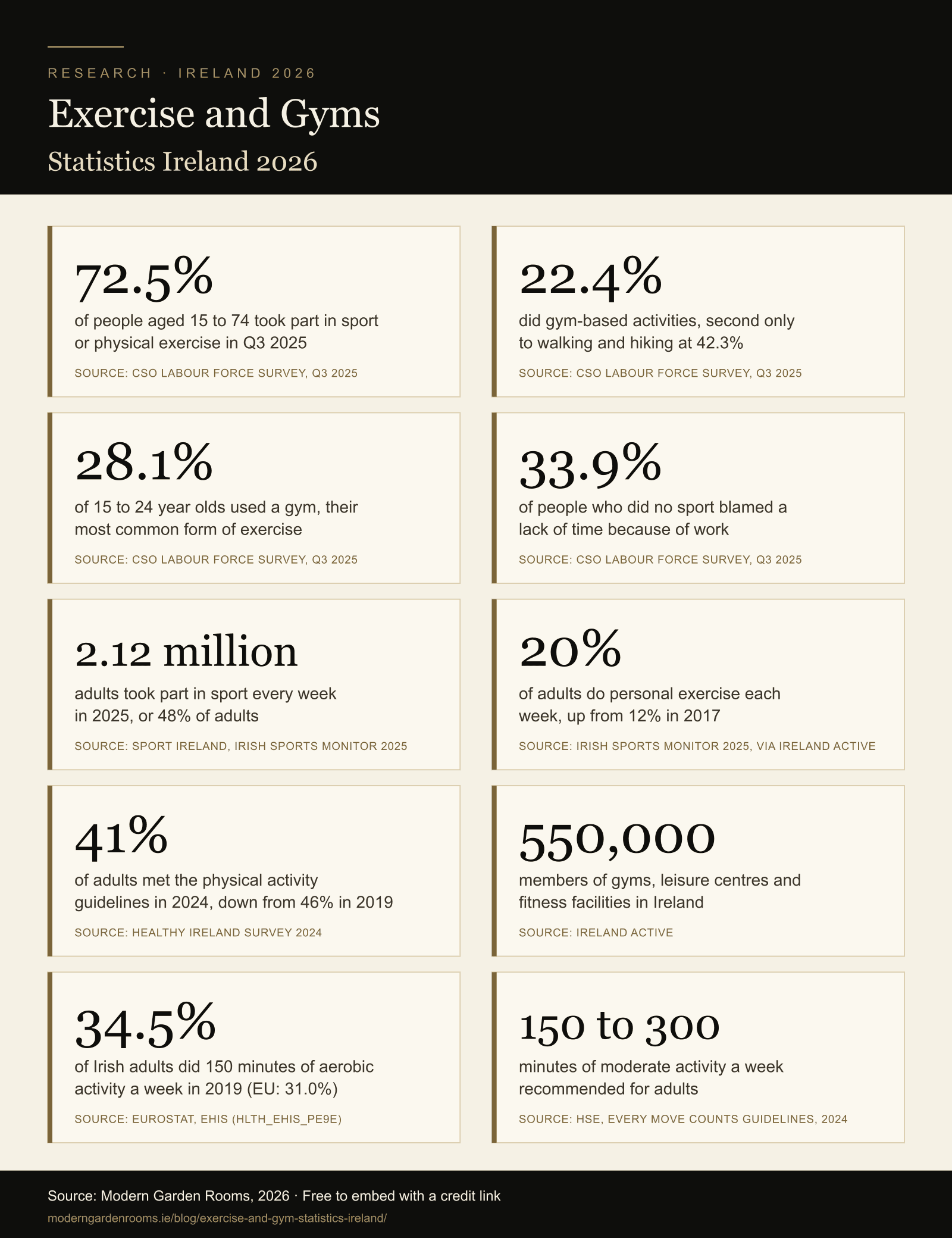
- 2,966,000 people aged 15 to 74, or 72.5%, took part in at least one sport or physical exercise in the third quarter of 2025. Source: CSO, Labour Force Survey Sports and Physical Exercise Q3 2025.
- Walking and hiking was the most common activity at 42.3%, and gym-based activities were second at 22.4%, ahead of swimming, running and cycling. Source: CSO, Labour Force Survey Q3 2025.
- Among 15 to 24 year olds, the gym was the most common activity at 28.1%, ahead of walking. Source: CSO, Labour Force Survey Q3 2025.
- Of people who did no sport or exercise, 33.9% said they lacked the time because of work and 22.5% because of family commitments. Source: CSO, Labour Force Survey Q3 2025.
- 48% of adults, about 2.12 million people, took part in sport in the previous week in 2025, the highest number recorded since the series began in 2007. Source: Sport Ireland, Irish Sports Monitor 2025.
- Weekly participation in personal exercise, which covers gym and fitness training, rose from 12% of adults in 2017 to 20% in 2025. Source: Irish Sports Monitor 2025 figures reported by Ireland Active, May 2026.
- 41% of people met the National Physical Activity Guidelines in 2024, down from 46% in 2019. Source: Healthy Ireland Survey 2024.
- An estimated 550,000 people are members of leisure, health and fitness facilities in Ireland. Source: Ireland Active.
- 34.5% of Irish adults did at least 150 minutes of aerobic activity a week in 2019, compared with 31.0% across the EU. Source: Eurostat, European Health Interview Survey, table hlth_ehis_pe9e.
- The national guidelines recommend 150 to 300 minutes of moderate activity a week for adults, or 75 to 150 minutes of vigorous activity. Source: HSE, Every Move Counts guidelines, March 2024.
Embed This Infographic
This infographic is free to use on your own site. Copy the code below and keep the credit link back to this page.
<a href="https://moderngardenrooms.ie/blog/exercise-and-gym-statistics-ireland/"><img src="https://moderngardenrooms.ie/images/blog/exercise-and-gym-statistics-ireland-infographic.png" alt="Exercise and Gym Statistics Ireland 2026 infographic by Modern Garden Rooms" width="1200" height="1560" style="max-width:100%;height:auto;border:0;" /></a>
<p>Source: <a href="https://moderngardenrooms.ie/blog/exercise-and-gym-statistics-ireland/">Exercise and Gym Statistics Ireland 2026</a> by Modern Garden Rooms</p>
Almost three million people exercised in late 2025
The newest national figures come from a special module in the CSO’s Labour Force Survey, published on 24 September 2026. It found that 2,966,000 people aged 15 to 74, or 72.5%, participated in at least one sport or physical exercise in the third quarter of 2025. Slightly more women took part than men, 1,503,300 against 1,462,700, and the participation rate was 72.9% for women and 72.1% for men.
Walking and hiking led every other activity, with 1,731,000 people or 42.3% taking part. Gym-based activities came second at 22.4%, followed by swimming at 9.8%, running at 9.3% and cycling at 6.9%. Among team sports, soccer was the most common at 4.7%, followed by Gaelic football at 3.9%, hurling or camogie at 2.2% and rugby at 0.7%. Women were more likely to walk, use a gym or swim, while men were more likely to cycle, run or play soccer, Gaelic games and golf.
The 27.5% of people who did nothing amount to about 1,125,000 people, a figure calculated from the CSO’s participation count and rate. That is the group every public health campaign is aimed at.
The gym is Ireland’s second most common form of exercise
The CSO figure of 22.4% for gym-based activities works out at roughly 916,000 people aged 15 to 74, calculated by applying the rate to the population implied by the CSO’s own counts. Gym use is strongly linked to working life. Among people in the labour force, 25.3% did gym-based activities, compared with 14.7% of those outside it, and the same group was twice as likely to run, at 10.9% against 5.1%. People outside the labour force were more likely to walk, at 46.0% against 40.9%.
Age matters even more. Gym-based activities were the most common form of exercise for 15 to 24 year olds at 28.1%, ahead of walking at 27.0% and soccer and Gaelic football at 13.6% each. Among 45 to 74 year olds the gym came second at 15.5%, a long way behind walking at 52.0%. Dublin had the highest gym participation of any region at 27.8%, which the CSO notes is 5.4 percentage points above the national rate.
Who exercises, and where
Younger people were the most active overall. The CSO found that 78.5% of 15 to 24 year olds took part in sport or exercise, compared with 70.8% of 25 to 44 year olds and 71.6% of 45 to 74 year olds. People in the labour force participated at 73.6% against 69.5% for those outside it.
By region, the Mid-West of Clare, Limerick and Tipperary had the highest participation at 74.7%, followed by the South-West at 74.5%, Dublin at 74.1% and the Mid-East at 73.2%. The lowest rates were in the South-East at 67.7%, the Midlands at 68.1% and the Border at 68.5%. Walking was the most common activity in every region. Dublin had the lowest share playing Gaelic football at 2.3% and the Border region the highest at 5.7%.
Why people exercise, and why they do not
The reasons are consistent. Of those who took part, 87.1% said they did so to improve their physical health and fitness, 49.5% to improve their mental wellbeing, 27.2% for the social element, 13.7% to improve performance and 9.4% to take part in competitions. Women were more likely than men to cite physical and mental health, at 87.9% and 51.1%, while men were more likely to cite the social side, performance and competition.
Time is the main barrier. Among people who did no sport or exercise, 33.9% said they lacked the time because of work and 22.5% because of family commitments. Illness, injury or disability was cited by 21.6% and lack of motivation by 19.5%. Together, the two time-related reasons account for 56.4% of non-participants, a share calculated from the CSO figures. Work was the leading reason for men at 41.0%, while family commitments led for women at 27.3%, followed by work at 26.7%. Many of those time-pressed workers are now at home for part of the week, as our remote working statistics for Ireland show.
Weekly sport participation is at a record
Sport Ireland’s Irish Sports Monitor uses a stricter measure: taking part in sport in the previous seven days. It interviews about 8,500 people aged 16 and over by telephone each year. In 2025, 48% of adults, about 2.12 million people, participated in sport in the past week, the highest number recorded since the survey began in 2007. The rate was not statistically different from 2024, when Sport Ireland reported 49% taking part, up from 47% in 2023.
Personal exercise, which is Sport Ireland’s term for gym and fitness training, is the most popular activity and the fastest growing. Ireland Active, the trade body for leisure facilities, reports from the 2025 survey that weekly participation in personal exercise rose from 12% in 2017 to 20% in 2025, that swimming stood at 8% and weight training at 4%, and that 30% of adults had taken up a new activity since 2019, with personal exercise the most common new activity at 27%. There is a social gradient: 24% of people in the ABC1 socio-economic groups do personal exercise each week compared with 16% of those in the C2DE groups.
Among 16 to 24 year olds, 70% took part in sport in the previous week in 2025, down from 73% in 2024, and 27% did personal exercise. Sports club membership across all adults reached 37%, or 1.61 million people, up from 35% in 2023 and 34% in 2017. The gap in participation between people with and without a disability was 19 percentage points in 2025, at 34% against 53%, narrower than the 22 points recorded in 2024.
Fewer than half of adults meet the activity guidelines
The HSE’s Every Move Counts guidelines, published in March 2024, recommend that adults do at least 2 hours and 30 minutes to 5 hours of moderate-intensity aerobic activity a week, or 1 hour 15 minutes to 2 hours 30 minutes of vigorous activity, and that children and adolescents average at least an hour a day. The HSE also notes that most adults spend at least 5 hours a day sedentary.
The Healthy Ireland Survey, which interviewed 7,398 people aged 15 and over between October 2023 and April 2024, found that 41% of people met the guidelines by being moderately active for at least 150 minutes a week, down from 46% when the question was last asked in 2019. Some 8% reported no physical activity at all in the previous seven days, unchanged since 2019, and 67% of those who fell short said they would like to be more active. The same survey found that 63% of men and 50% of women recorded overweight or obese measurements, unchanged since 2022. Sport Ireland’s separate measure puts approximately 40% of adults in its highly active category in 2025, a slight decline on 2024 that it attributes to a 4 percentage point fall in recreational walking.
Ireland compared with the European Union
The European Health Interview Survey asks the same questions in every member state. Ireland is above the EU average on each measure. 34.5% of Irish adults did at least 150 minutes of aerobic activity a week in 2019, compared with 31.0% across the EU, and 22.7% did muscle-strengthening activity at least twice a week, compared with 19.7%. The Irish aerobic figure rose from 29.1% in 2014. The differences of 3.5 and 3.0 percentage points are calculated from the Eurostat table, which was last updated in January 2024. The next wave of the survey will provide figures for 2025.
| Measure | Ireland 2014 | Ireland 2019 | EU 2019 |
|---|---|---|---|
| At least 150 minutes of aerobic activity a week | 29.1 | 34.5 | 31.0 |
| Muscle-strengthening activity at least twice a week | 24.7 | 22.7 | 19.7 |
| Both aerobic and muscle-strengthening | 13.2 | 16.1 | 13.6 |
Source: Eurostat, table hlth_ehis_pe9e, extracted 14 October 2026. Figures are for people aged 15 and over.
Gym membership and the fitness industry
Ireland has no audited count of gym members. The trade body Ireland Active, which represents over 450 leisure centres, gyms, swimming pools and fitness facilities, estimates that 550,000 Irish people are members of leisure, health and fitness facilities, that the industry employs approximately 10,000 people and that it generates an estimated €500 million a year for the economy. Its chief executive said in May 2026 that almost one third of Irish people now use its members’ facilities and services.
A separate estimate by the trade magazine Health Club Management, published in 2026, puts the figure at around 600,000 to 700,000 health club members, a penetration of approximately 11 to 13%, across 450 to 500 facilities with an annual market worth of €300 million to €350 million. The magazine describes these as informed estimates rather than audited totals. By way of comparison, the CSO’s 22.4% of people doing gym-based activities is roughly double either membership estimate, which suggests that a large share of gym exercise happens outside paid membership, at home, at work or on a pay-as-you-go basis.
Children and teenagers
The all-island Children’s Sport Participation and Physical Activity study surveyed over 8,500 young people aged 10 to 19 in 2022. It found that 15% met the recommended physical activity guidelines, an increase of 2 percentage points since 2018. Some 96% of primary and 84% of post-primary students played some form of sport at least once a week, and primary students reported an average of 85 minutes of physical education a week. Active travel to school fell, with 37% walking, cycling or scooting compared with 42% in 2018.
How these statistics were compiled
This page draws on the CSO Labour Force Survey module on sports and physical exercise, Sport Ireland’s Irish Sports Monitor for 2024 and 2025, the Healthy Ireland Survey 2024, the HSE physical activity guidelines, Eurostat, Ireland Active and the Children’s Sport Participation and Physical Activity study. Every source was opened and every figure checked on 14 October 2026. Figures described as calculated were worked out from the cited source and are not published by it: the number of people doing gym-based activities, the number doing no activity, the combined share citing work and family time, and the Ireland to EU gaps.
Three limitations apply. The three national surveys use different questions, age ranges and reference periods, so their headline rates should not be compared with one another. Some Irish Sports Monitor 2025 figures are taken from Ireland Active’s account of the report, because Sport Ireland’s summary PDF could not be read as text at the time of writing. The Healthy Ireland Survey 2025, published in November 2025, did not include a physical activity module, so 2024 remains the latest guideline figure.
The page will be updated when the Healthy Ireland Survey next measures physical activity, when the Irish Sports Monitor 2026 is published in spring 2027, and when Eurostat releases the 2025 wave of the European Health Interview Survey. The year in the title identifies when the page was last compiled. It does not mean every statistic was measured in 2026.
How Modern Garden Rooms helps
The two figures that matter most for a home gym sit side by side in the CSO data: 22.4% of people already train in a gym, and the single biggest reason the rest do not is a lack of time because of work. A gym at the end of the garden removes the journey, the queue for equipment and the membership fee from that equation.
Modern Garden Rooms designs and builds fully insulated garden gym rooms across Dublin and Leinster, with reinforced floors, ventilation and the sound dampening a training space needs to be used all year. Most fit within the 30 square metre planning exemption, which our planning permission guide explains, and a free site visit will confirm what your garden allows.
