
Remote and hybrid work remain a significant part of working life in Ireland, even as more people have returned to offices and other workplaces. This roundup was prepared in 2026, but its statistics cover several clearly labelled periods: the newest official prevalence figures measure Q4 2025, Census detail comes from April 2022, and the newest worker-preference survey was conducted in early 2026.
Key remote working statistics at a glance
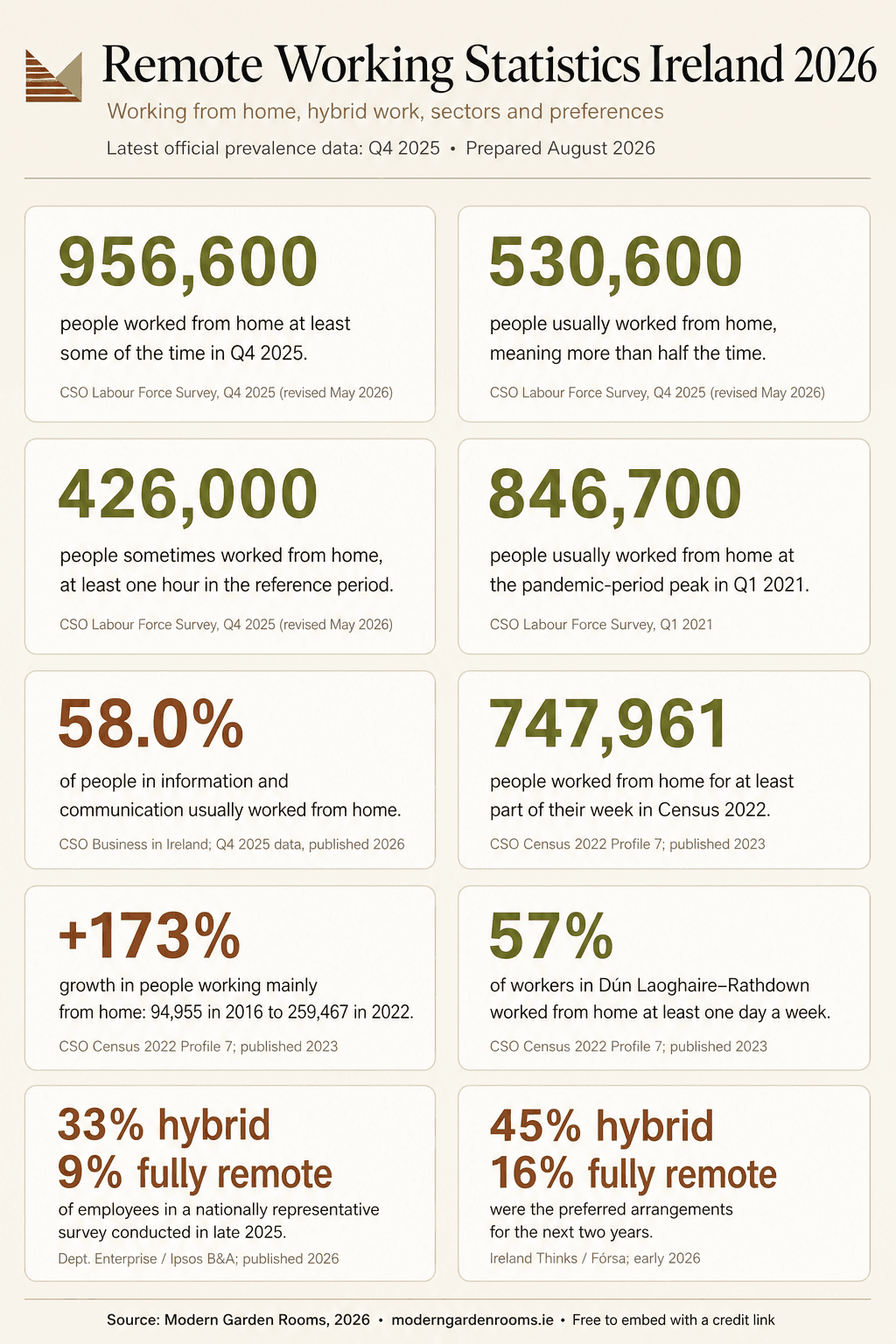
- An estimated 956,600 people worked from home at least some of the time in Q4 2025, based on the revised CSO Labour Force Survey.
- Within that total, 530,600 people usually worked from home, meaning more than half the time, in Q4 2025.
- A further 426,000 people sometimes worked from home, defined by the CSO as at least one hour in the reference period, in Q4 2025.
- The number who usually worked from home reached a pandemic-period peak of 846,700 people in Q1 2021, according to the CSO time series.
- In information and communication, 58.0% of people in employment usually worked from home in Q4 2025, the highest published sector share in the CSO sector table.
- Census 2022 counted 747,961 people at work who worked from home for at least some part of their week, as detailed in the CSO Census employment profile.
- The narrower Census count of people working mainly at or from home rose 173% between 2016 and 2022, from 94,955 to 259,467, in the same Census series.
- In Dún Laoghaire–Rathdown, 57% of workers worked from home at least one day a week in Census 2022, the highest local share reported in the CSO press statement.
- A nationally representative employee survey conducted in late 2025 classified 33% of employees as hybrid and 9% as fully remote, while 57% were fully workplace-based, according to the Government’s statutory review.
- When workers were asked in early 2026 about their preferred arrangement for the next two years, 45% chose hybrid and 16% chose fully remote work, while 25% preferred fully on-site work, in the Ireland Thinks research commissioned by Fórsa.
Embed This Infographic
This infographic is free to use on your own site. Copy the code below and keep the credit link back to this page.
<a href="https://moderngardenrooms.ie/blog/remote-working-statistics-ireland-2026/"><img src="https://moderngardenrooms.ie/images/blog/remote-working-statistics-ireland-2026-infographic.png" alt="Remote Working Statistics Ireland 2026 infographic by Modern Garden Rooms" width="1024" height="1536" style="max-width:100%;height:auto;border:0;" /></a>
<p>Source: <a href="https://moderngardenrooms.ie/blog/remote-working-statistics-ireland-2026/">Remote Working Statistics Ireland 2026</a> by Modern Garden Rooms</p>
Almost one million people worked from home in late 2025
The clearest current national estimate comes from the CSO Labour Force Survey. Of the 2,832,900 people in employment in Q4 2025, an estimated 956,600 worked from home at least some of the time. This total combines two CSO categories rather than describing one uniform working pattern.
The larger group, comprising 530,600 people, said they usually worked from home. In the Labour Force Survey, “usually” means working from home more than half the time. The other 426,000 people sometimes worked from home, which means at least one hour during the survey reference period. Neither category should automatically be relabelled as fully remote or hybrid because those terms are defined differently in other surveys.
At the same time, 1,865,600 people said they never worked from home. A separate CSO presentation reported that 65.9% of people in employment never worked at home, while 18.7% usually did so in Q4 2025. The percentage table was published shortly before a small benchmark revision, so the revised Labour Force Survey counts are used throughout this article.
The most recent annual comparison points towards greater workplace attendance, but it does not settle the longer-term direction. The number working from home at least some of the time fell by 16,100 people, or 1.7%, between Q4 2024 and Q4 2025. Over the same comparison, the number who never worked from home rose by 74,200, or 4.1%. One year of change should not be presented as proof that remote work is disappearing.
Remote working grew sharply from its pre-pandemic base
The quarterly series shows how far working patterns moved during the pandemic. The number who usually worked from home peaked at 846,700 in Q1 2021, when public-health restrictions strongly influenced workplace attendance. The Q4 2025 estimate of 530,600 was below that exceptional peak, but remote work remained a substantial feature of the labour market.
Census data provides a longer comparison using a different measure. A Census commuting question recorded 94,955 people working mainly at or from home in 2016 and 259,467 in 2022, an increase of 173%. This is a count of people whose main work location was home. It is narrower than the separate Census question that found 747,961 people worked from home for at least part of their week.
The distinction matters. A person attending an office most days and working from home one day a week may be included in the broader “ever works from home” figure without appearing in the “mainly from home” count. Keeping both measures allows the article to describe flexible work without pretending that every data source asks the same question.
Remote work varies greatly by industry and occupation
Remote work is concentrated in jobs that can be performed away from a physical site. In Q4 2025, 58.0% of people in information and communication usually worked from home. The comparable share was 52.3% in financial, insurance and real-estate activities, 38.9% in professional, scientific and technical activities, and 26.8% in public administration and defence.
The pattern was very different in sectors dominated by site-based or public-facing work. The published shares usually working from home were 9.0% in human health and social work, 7.1% in construction, and 6.6% in wholesale and retail, including motor-vehicle repair. The CSO suppressed figures for transportation and storage and for accommodation and food services because of confidentiality, so those cells cannot be treated as zero.
Census 2022 offers more detailed occupational evidence. Between 90% and 95% of workers in several listed IT and business-management occupations worked from home for at least part of the week. These occupations included programmers, developers, management consultants, project managers and web designers. The Census also counted more than 52,000 people in information and communication who worked mainly from home, more than nine times the 2016 number.
Geography and commuting shape access to remote work
The 2022 Census found substantial differences between counties and local-authority areas. Dún Laoghaire–Rathdown had the highest reported share, with 57% of workers working from home one or more days a week. At the other end of the published comparison, the share was 21% in both Monaghan and Longford. These figures describe Census night conditions in April 2022 and should not be presented as current county rankings.
Many of those home workers share the house with family. Census 2022 counted 522,486 adults living with their parents, and over half of them were at work, as set out in our adults living with parents statistics for Ireland.
Commuting remains part of the reason flexible work matters to many households. In an early-2026 survey of 1,191 workers, 12% reported a one-way journey of at least one hour on days they travelled to their usual workplace. The reported share was 21% among Leinster respondents outside the survey’s Dublin category, compared with 7% in Dublin. These are survey estimates with unreported regional confidence intervals, not Census commute counts.
The same research found that 77% of remote or hybrid workers said they spent more of their day-to-day money in their local area because of remote work. Among that group, 49% said this was mainly money they had previously spent near their workplace. The finding indicates a reported shift in where spending happens, rather than a measured increase in total local expenditure.
Hybrid work is more common than fully remote work
Different studies use different labels, but recent employee research points towards hybrid work as the more common flexible arrangement. A nationally representative survey of 1,041 employees, conducted for the statutory review in late 2025, classified 57% as fully workplace-based, 33% as hybrid and 9% as fully remote. Rounding accounts for the categories totalling 99%.
An early-2026 survey using a different panel and definition found that 38% of workers currently worked remotely at least one day a week, 19% had previously done so but no longer did, and 42% had never worked remotely. Among remote or hybrid respondents working a five-day week, the average was 2.9 remote-working days. This is not an average for the entire workforce.
Earlier CSO evidence shows where remote work was taking place during the pandemic period. Among employees who had used remote work during the previous year, 75.6% had worked from home in the four weeks before their Q3 2021 interview. Only 0.5% reported using a hub or co-working space. Respondents could select more than one location, so those percentages are not mutually exclusive.
The intensity of home working also changed sharply during that period. Of employees who had remote-worked in the prior year, 40.9% worked remotely on at least 17 days during the previous four weeks. The recalled pre-COVID equivalent was 2.2%. Both figures use a restricted denominator and should not be applied to all employees.
Worker preferences favour flexibility
Current access to remote work is lower than the level of flexibility many surveyed workers would prefer. When asked in early 2026 about their preferred arrangement for the following two years, 45% chose hybrid working and 16% chose fully remote working. A further 25% preferred fully on-site work, with the balance expressing no preference or uncertainty. The combined flexible-work preference must not be described as a preference to work entirely from home.
Respondents with remote or hybrid experience also reported perceived everyday benefits. Compared with mostly on-site work, 74% agreed that remote or hybrid work reduced their stress, 68% agreed that it improved their productivity, and 60% agreed that it improved their ability to switch off after work. These are self-reported perceptions. They do not measure clinical stress or objectively prove that remote work raised output.
Older official evidence points in a similar direction while carrying an important pandemic-era limitation. In Q3 2021, 92.1% of employees who had worked remotely during the previous year were satisfied or very satisfied with their job, compared with 86.9% among those who had not. Life satisfaction was 94.1% and 90.8% respectively. These differences are associations and cannot show that remote work caused higher satisfaction.
Remote-work access depends on the employer and the role
Remote work cannot be offered uniformly across the economy. In the national employer survey conducted for the statutory review, 44% of employers said it was not possible for their employees to work remotely. That is an employer assessment of operational feasibility, not a count of employees whose jobs cannot be performed remotely.
Organisation size was strongly associated with reported availability. Remote work was considered viable by 90% of employers with at least 250 employees, compared with 54% of micro-enterprises employing between one and nine people. By the report’s broad sector groupings, 78% of employers in professional and financial services could offer remote work, compared with 34% in distribution, transport and hospitality. The subgroup margins of error were not published and will be wider than those for the overall sample.
Ireland’s legal right to request a remote-working arrangement came into operation in March 2024, but awareness remained limited in late 2025. Only 48% of employees knew the legal right existed, while 35% knew about the WRC Code of Practice. Awareness does not guarantee that a role is suitable or that a particular request must be granted.
Among employees who used the formal process, the review reported that 94% of requests were approved fully or partly. The national employee survey recorded a 7% outright-refusal rate and found that 33% of requests were partially approved. These figures describe the relatively small group that made a formal request, not every informal conversation between workers and managers. Rounding and the report’s separate survey groups also mean the percentages should not be forced into one reconstructed total.
How these statistics were compiled
This roundup uses six primary-source publications reviewed on 20 August 2026. The CSO Labour Force Survey supplies the newest official national prevalence estimates, including revised Q4 2025 counts. The CSO Business in Ireland 2025 chapter supplies published sector percentages. Census 2022 provides detailed counts by usual work location, days, county and occupation.
The CSO Personal and Work-Life Balance Survey adds household, location and satisfaction measures from Q3 2021. Those results are retained because they answer questions not covered by the quarterly Labour Force Survey, but they are clearly labelled as pandemic-era findings. The Government’s statutory review adds weighted national employee and employer surveys conducted in late 2025. The review reports an overall employee-survey confidence interval of approximately 3.2 percentage points at the 95% confidence level, while subgroup uncertainty is greater.
Finally, the 2026 Ireland Thinks research commissioned by Fórsa contributes recent preferences, perceived effects and commuting experiences. It used a weighted panel of 1,191 workers recruited through a mixture of probability and non-probability methods. Estimate-specific confidence intervals were not published, so its findings are treated as survey evidence rather than official population counts.
No projections are presented as observed outcomes. Where publications use incompatible definitions, their figures are explained separately rather than combined. The year 2026 in the title identifies the roundup’s preparation year; it does not imply that every statistic was measured in 2026.
A dedicated workspace for people who already work from home
These statistics show that working from home remains common, but they do not prove that any particular room design increases productivity, reduces stress or changes an employer’s remote-work policy. The practical need is simpler: people who already work remotely may want a comfortable place that separates paid work from the rest of the home.
Modern Garden Rooms designs fully insulated garden offices for year-round work across Dublin and Leinster. A separate garden workspace can provide a defined location for focused work, calls and equipment without turning the kitchen table or a shared living space into a permanent office. Its suitability will still depend on the household, the garden, planning requirements and the person’s actual working arrangement.
