
First-time buyers are the largest group in the Irish mortgage market and the group most public policy is aimed at, yet the numbers that describe them sit in five different places: the banks’ lending figures, the CSO’s purchase records, the Census, the Central Bank’s lending rules and the State’s support schemes. This page brings them together for journalists, researchers and families working out what buying a first home involves in 2026. Each figure is labelled with the period it measures and the body that published it.
Key first-time buyer statistics for Ireland at a glance
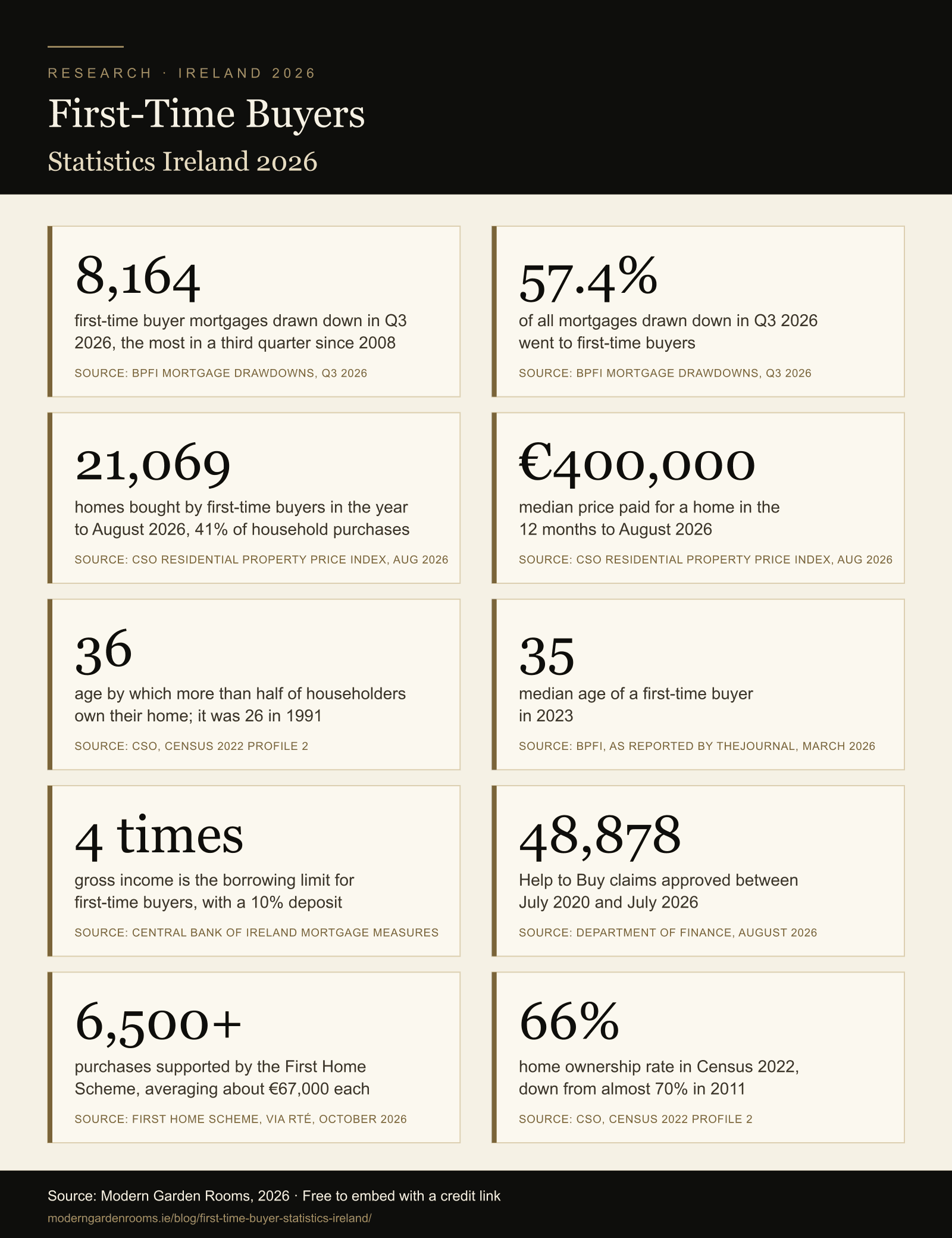
- First-time buyers drew down 8,164 mortgages in the third quarter of 2026, the highest third-quarter volume since 2008. Source: BPFI, Mortgage Drawdowns Q3 2026.
- They accounted for 57.4% of all mortgages drawn down in that quarter and 58.3% of the value. Source: BPFI, Mortgage Drawdowns Q3 2026.
- First-time buyer owner-occupiers made 21,069 purchases in the 12 months to August 2026, or 41.0% of all household purchases. Source: CSO, Residential Property Price Index August 2026.
- The median price paid for a home in the 12 months to August 2026 was €400,000, and prices rose 5.1% in the year. Source: CSO, Residential Property Price Index August 2026.
- The median age of a first-time buyer was 35 in 2023. Source: BPFI figure reported by TheJournal, March 2026.
- By the age of 36, more than half of householders own their home. In 1991 that age was 26. Source: CSO, Census 2022 Profile 2.
- A first-time buyer can borrow up to 4 times gross income and needs a deposit of at least 10%. Source: Central Bank of Ireland, mortgage measures.
- 48,878 Help to Buy claims were approved between 1 July 2020 and 22 July 2026, worth up to €30,000 each. Source: Department of Finance, August 2026.
- The First Home Scheme has supported over 6,500 purchases with almost €440 million, an average of about €67,000 a home. Source: First Home Scheme figures reported by RTÉ, October 2026.
- The rate of home ownership was 66% in Census 2022, down from 68% in 2016 and almost 70% in 2011. Source: CSO, Census 2022 Profile 2.
Embed This Infographic
This infographic is free to use on your own site. Copy the code below and keep the credit link back to this page.
<a href="https://moderngardenrooms.ie/blog/first-time-buyer-statistics-ireland/"><img src="https://moderngardenrooms.ie/images/blog/first-time-buyer-statistics-ireland-infographic.png" alt="First-Time Buyer Statistics Ireland 2026 infographic by Modern Garden Rooms" width="1200" height="1560" style="max-width:100%;height:auto;border:0;" /></a>
<p>Source: <a href="https://moderngardenrooms.ie/blog/first-time-buyer-statistics-ireland/">First-Time Buyer Statistics Ireland 2026</a> by Modern Garden Rooms</p>
How many first-time buyers are buying
The CSO counts first-time buyers from the stamp duty returns filed with Revenue. In the 12 months to August 2026, 51,415 dwelling purchases by households were filed, and 21,069 of them, or 41.0%, were by first-time buyer owner-occupiers. Former owner-occupiers bought 25,604 homes, or 49.8%, and non-occupiers such as investors bought the remaining 4,742, or 9.2%.
The monthly figures are rising. There were 1,811 first-time buyer purchases filed in August 2026, an increase of 12.0% on the 1,617 filed in August 2025. Of those, 659 were new homes and 1,152 were existing homes, so new homes made up 36% of first-time buyer purchases in the month, a share calculated from the CSO counts.
Mortgage lending to first-time buyers is at an 18-year high
The banks’ own figures show the same trend from the lending side. Banking and Payments Federation Ireland reports that first-time buyers drew down 8,164 mortgages in the third quarter of 2026, the highest third-quarter volume since 2008. They were the largest segment of the market, with 57.4% of the 14,217 mortgages drawn down and 58.3% of the €4,598 million lent. Total drawdowns were up 13.1% in volume and 15.7% in value on the third quarter of 2025.
Momentum has built through the year. In the second quarter, first-time buyers drew down 6,941 mortgages worth almost €2.3 billion, and first-time buyer lending in the first half of 2026 reached €4.1 billion, the highest first-half figure since the series began in 2003. Across the first nine months of 2026, 35,449 mortgages of all types were drawn down, worth almost €11.4 billion, with volumes up 8.2% and values up 12% on the same period of 2025.
Approvals point to more of the same. In September 2026 lenders approved 3,153 first-time buyer mortgages worth €1,038 million, which was 58.5% of all approvals by volume. That works out at an average approval of about €329,000 per first-time buyer, a figure calculated from the two BPFI totals. In the year to September 2026, 56,486 mortgages of all types were approved, worth over €18.3 billion.
How old first-time buyers are
First-time buyers are older than they used to be. BPFI put the median age of a first-time buyer at 35 in 2023, as reported by TheJournal in March 2026, and the chief executive of Cairn Homes said in the same report that the typical first-time buyer of its homes had moved from 31 or 32 to 38 or 39 in recent years. The CSO, which measures all buyers and not just first-time buyers, found that the median age of purchasers stood at 40 in 2024, unchanged since 2021, at 38 for joint purchasers and 42 for people buying alone. Almost a third of people who bought in 2024 were aged 35 or under.
The Census shows the long-run shift most clearly. In 2022, more than half of householders owned their home by the age of 36. That crossover age was 26 in 1991 and has risen at every census since. The age by which two-thirds of householders owned their home rose from 28 in 1991 to 44 in 2022.
| Census | Age |
|---|---|
| 1991 | 26 |
| 2002 | 27 |
| 2006 | 28 |
| 2011 | 32 |
| 2016 | 35 |
| 2022 | 36 |
Source: CSO, Census 2022 Profile 2 press statement, published 27 July 2023.
Many of those buyers spend the intervening years in the family home. The CSO matched 2022 purchasers to their Census forms and found that approximately 8% were living with their parents at the time, and our statistics on adults living with their parents in Ireland show how common that has become.
What first-time buyers pay and what they can borrow
The CSO does not publish a separate price for first-time buyers, but the market they are buying into is well measured. Households paid a median price of €400,000 for a home in the 12 months to August 2026, and prices rose 5.1% in the year, by 3.9% in Dublin and 6.2% outside it. Median prices ranged from €685,000 in Dún Laoghaire-Rathdown to €199,000 in Longford.
The Central Bank’s mortgage measures set the ceiling on borrowing. Lenders may advance a maximum of 4 times gross income for first-time buyers, against 3.5 times for second and subsequent buyers, and both groups need a minimum deposit of 10%. Lenders may write 15% of their first-time buyer lending above those limits.
Applied to the median price, those rules mean a deposit of €40,000 and a mortgage of €360,000, which requires a gross household income of €90,000 at four times income. Those three figures are calculated from the CSO price and the Central Bank limits. For comparison, the CSO found that the national median income of residential property purchasers was €84,400 in 2024, and €101,200 for joint purchasers, which is why most first homes are bought by two people and why deposit supports matter.
State supports: Help to Buy and the First Home Scheme
Help to Buy refunds income tax and deposit interest tax paid over the previous four years to first-time buyers of new homes, up to the lesser of €30,000 or 10% of the purchase price. The Department of Finance reports that 48,878 Help to Buy claims were approved between 1 July 2020 and 22 July 2026, covering 88,532 applicants. Of those claims, 37,983 were for purchases of newly built homes and 10,895 were for self-builds. Dublin had the most approved claims at 7,549, followed by Cork at 7,432, Kildare at 5,752 and Meath at 4,646. Self-builds made up 22% of all claims but only 86 of the Dublin total, a contrast calculated from the Department’s county table.
The First Home Scheme is a shared equity scheme in which the State and participating banks take a stake of up to 30% in a new home. By its third-quarter 2026 update, as reported by RTÉ in October 2026, it had supported over 6,500 purchases with almost €440 million, issued over 12,000 approvals since 2022 and registered over 27,000 potential buyers. The average support was about €67,000, or 17% of an average price of about €395,000. More than a third of all drawdowns, 37%, came in the previous 12 months, and 72% of live approvals were in Dublin, Cork, Kildare, Meath and Wicklow.
New homes, second-hand homes and self-builds
First-time buyers still buy more second-hand homes than new ones. In the third quarter of 2026, 3,244 first-time buyer mortgages were for new properties, up 7.5% year on year and the highest third-quarter level since 2007. A further 4,920 were for second-hand homes, the second highest quarterly volume in the series, with a record value of €1.56 billion. First-time buyer self-build mortgages fell 5.8% to 666. New properties therefore made up about 40% of first-time buyer drawdowns in the quarter, a share calculated from the BPFI counts.
Where a buyer lives shapes which route they take. In the Help to Buy county figures, self-builds account for most approved claims in western counties: 578 of 898 in Mayo, 562 of 962 in Donegal and 1,124 of 2,356 in Galway. In the commuter counties the pattern reverses, with 231 self-builds among 5,752 claims in Kildare and 655 among 4,646 in Meath, where first-time buyers overwhelmingly buy new homes in estates.
Home ownership is still falling
Record lending has not yet reversed the long decline in ownership. The rate of home ownership was 66% in Census 2022, down from 68% in 2016 and almost 70% in 2011. More than 330,000 homes were rented from a private landlord in April 2022, an increase of 7% since 2016, and the average weekly rent paid to private landlords rose from €200 to €273 over the same period. The number of homes owned with a mortgage fell by 1% to 531,207, while homes owned outright rose 11% to nearly 680,000. The next Census, in April 2027, will show whether the recent rise in first-time buyer numbers has moved the ownership rate.
How these statistics were compiled
This page draws on Banking and Payments Federation Ireland’s mortgage drawdown and approval reports, the CSO’s Residential Property Price Index, purchaser characteristics release and Census 2022, the Central Bank’s mortgage measures and the Department of Finance’s Help to Buy figures. Every source was opened and every figure checked on 6 November 2026. Figures described as calculated were worked out from the cited sources and are not published by them: the new home share of first-time buyer purchases and drawdowns, the average first-time buyer approval, the deposit, loan and income implied by the median price, and the self-build share of Help to Buy claims.
Three limitations apply. The median first-time buyer age and the First Home Scheme figures are taken from press reports that name their source, because the underlying publications were not available as text at the time of writing. The CSO median price covers all household buyers, not first-time buyers alone. BPFI counts mortgages and the CSO counts purchases, so the two series will never match exactly, because some first-time buyers pay cash and some mortgages are for self-builds that involve no purchase.
The page will be updated when the CSO publishes its September 2026 price index in mid-November, when BPFI publishes fourth-quarter drawdowns in January 2027, and when the CSO publishes its planned analysis of first-time buyers. The year in the title identifies when the page was last compiled. It does not mean every statistic was measured in 2026.
How Modern Garden Rooms helps
The arithmetic above explains why so many first homes are bought in a buyer’s mid-thirties: a €40,000 deposit takes years to save, and those years are usually spent renting or in a childhood bedroom. A self-contained home in the family garden is one way to give an adult son or daughter independence while they save.
Modern Garden Rooms designs and builds self-contained garden homes of 32 to 45 square metres and granny flats for family members across Dublin and Leinster. Since July 2026 these can be built behind many houses without a planning application, subject to the conditions set out in our planning permission guide. A free site visit will confirm what your garden allows.
