
More young adults live with their parents in Ireland than in most of the European Union, and the share has risen sharply since 2010. This page gathers the official figures in one place for journalists, researchers and families: how many adults live at home, how old they are, where they live, why they stay, and what rents, house prices and new planning rules mean for them. Each figure is labelled with the period it measures, because the Census, Eurostat and the rent and price series all run on different calendars.
Key statistics on adults living with parents in Ireland at a glance
- Census 2022 counted 522,486 adults aged 18 and over living with their parents, which was 14% more than in 2016. Source: CSO, Census 2022 Profile 3.
- In 2025, 61.7% of people aged 18 to 34 in Ireland lived with their parents, compared with an EU average of 49.8%. Source: Eurostat, EU-SILC table ilc_lvps08.
- The Irish share of 18 to 34 year olds living at home was 43.7% in 2010 and peaked at 64.0% in 2022. Source: Eurostat, EU-SILC table ilc_lvps08.
- On the Census measure, 41% of people aged 18 to 34 lived with their parents in 2022, up from 37% in 2016 and 32% in 2011. Source: CSO feature article, May 2024.
- The estimated average age of leaving the parental home in Ireland was 26.9 years in 2025, against an EU average of 26.3 years. Source: Eurostat, table yth_demo_030.
- One in five people aged 30 (20%) lived with their parents in Census 2022, up from 13% in 2011. Source: CSO, Census 2022 Profile 3.
- Among 25 year olds still living in the parental home, 62.4% said they were doing so for mostly financial reasons. Source: CSO, Growing Up in Ireland Cohort ’98 at age 25.
- The standardised average rent for a new tenancy reached €1,839 a month in Q1 2026, an annual increase of 9.1%. Source: RTB/ESRI Rent Index, Q1 2026.
- The median price of a home bought in the 12 months to July 2026 was €399,999. Source: CSO, Residential Property Price Index July 2026.
- Since 27 July 2026, a detached home of 32 to 45 square metres can be built in the rear garden of a house without planning permission, subject to 20 conditions. Source: S.I. No. 340 of 2026.
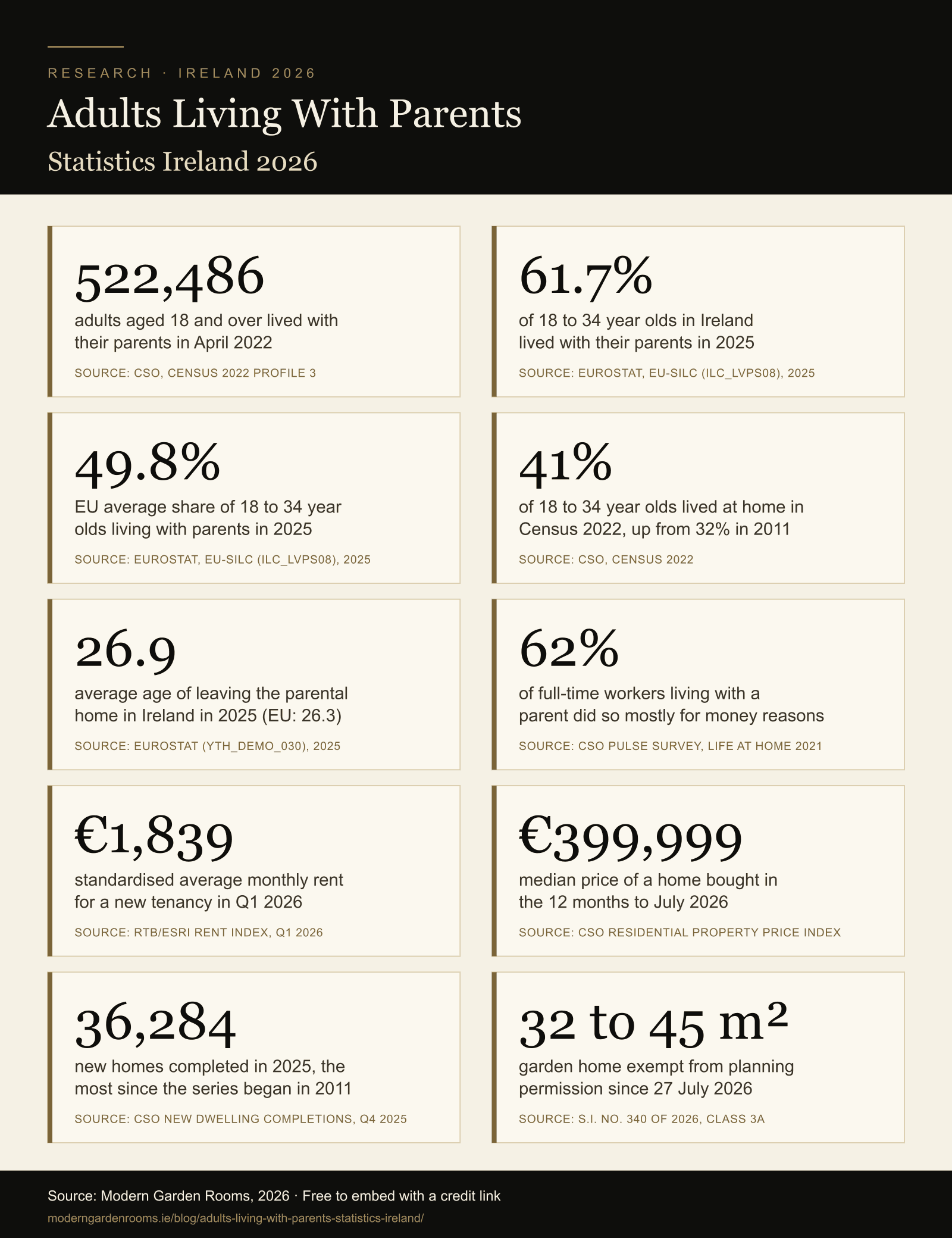
Embed This Infographic
This infographic is free to use on your own site. Copy the code below and keep the credit link back to this page.
<a href="https://moderngardenrooms.ie/blog/adults-living-with-parents-statistics-ireland/"><img src="https://moderngardenrooms.ie/images/blog/adults-living-with-parents-statistics-ireland-infographic.png" alt="Adults Living With Parents Statistics Ireland 2026 infographic by Modern Garden Rooms" width="1200" height="1560" style="max-width:100%;height:auto;border:0;" /></a>
<p>Source: <a href="https://moderngardenrooms.ie/blog/adults-living-with-parents-statistics-ireland/">Adults Living With Parents Statistics Ireland 2026</a> by Modern Garden Rooms</p>
More than half a million adults live with their parents
The most complete count comes from the Census. In April 2022 there were 522,486 adults aged 18 and over living with their parents, which the CSO defines as a son or daughter of the head of the household who usually lived there. That was 63,612 more people than in 2016, a rise of 14%, and 83,008 more than in 2011, a rise of 19%, according to the CSO press statement on Profile 3.
The total grew mostly because the adult population grew. Adults living with their parents made up 13% of all adults aged 18 and over in each of the last three censuses. The change is concentrated in particular ages rather than spread evenly. Some 22% of all 18 to 50 year olds lived with their parents in 2022, up from 19% in 2011 and 20% in 2016.
Most of these adults have jobs. Over half were at work in April 2022, including 54% of the men and 50% of the women, while 37% of the women and 27% of the men were students. Only 8% of the men and 4% of the women were unemployed. Nearly 25,000 adults living with their parents were unpaid carers, which was 50% more than in 2016, and over 40% of those carers were aged over 40. All of these figures come from the Census 2022 chapter on adults living with their parents. For the many who work from the family home, our remote working statistics for Ireland set out how common that arrangement has become.
Living at home by age and sex
Living with parents is close to universal at 18 and then falls with each year of age, but it now falls more slowly than it used to. In Census 2022, 81% of 18 and 19 year olds lived with their parents, compared with 78% in 2011. Over 61% of 20 to 24 year olds did so, up from 54% in 2011 and 59% in 2016.
The sharpest movement is among people in their late twenties and early thirties. Almost one quarter of all 25 to 34 year olds, 23%, lived in the same household as their parents in 2022, compared with 17% in 2011. At age 28 the share was 28%. At age 30 it was 20%, up from 13% in 2011. The CSO also reports that 24 was the age at which more than half of people no longer lived with their parents in 2022, one year later than the cut-off of 23 recorded in 2011.
The oldest group is small but growing fastest. The number of adults aged 50 and over living with their parents increased by 3,796, or 26%, between 2016 and 2022, and by 6,730, or 56%, since 2011. The CSO describes this as the largest percentage increase of any age group. Men are more likely than women to live at home: 57% of adults living with their parents in 2022 were male, slightly down from 59% in both 2011 and 2016.
Where adults are most likely to live with their parents
The pattern is strongest in the suburbs of Dublin. Among local authority areas, South Dublin had the highest share of adults living with their parents at 16%, while Galway City had the lowest at 9%. Cities with large student and young renter populations tend to record low shares, because the young adults counted there have already moved out of a family home somewhere else.
The contrast is wider at neighbourhood level. In the Palmerstown-Fonthill local electoral area in South Dublin, one in every five adults, or 3,380 people, lived with their parents. In the North Inner City area of Dublin City the share was 5%. These are April 2022 figures and the next comparable local count will come from the 2027 Census.
Ireland compared with the European Union
Eurostat publishes an annual measure for every member state using the EU Survey on Income and Living Conditions. In 2025, 61.7% of people aged 18 to 34 in Ireland lived with their parents, compared with 49.8% across the EU. The gap of 11.9 percentage points is calculated from those two figures. Eurostat revised the EU series in September 2026, so the EU average quoted here may differ slightly from news reports published earlier in the year.
Ireland was below the EU average as recently as 2015. The Irish share stood at 43.7% in 2010, passed the EU figure in 2016, and reached a peak of 64.0% in 2022. It has moved between 60% and 63% in the three years since. Over the same fifteen years the EU average barely changed, moving from 48.7% to 49.8%. The Irish increase of 18.0 percentage points between 2010 and 2025 is calculated from the Eurostat series.
| Year | Ireland | EU average |
|---|---|---|
| 2010 | 43.7 | 48.7 |
| 2015 | 48.7 | 50.2 |
| 2019 | 57.0 | 50.5 |
| 2021 | 62.1 | 49.7 |
| 2022 | 64.0 | 49.7 |
| 2023 | 60.4 | 49.7 |
| 2024 | 62.2 | 49.1 |
| 2025 | 61.7 | 49.8 |
Source: Eurostat, table ilc_lvps08, extracted 22 September 2026.
The difference is most visible among people who would once have formed their own household. In 2025, 38.4% of 25 to 34 year olds in Ireland lived with their parents, against an EU average of 30.1%. In 2010 the Irish figure for that age group was 21.2%. The Irish share of 25 to 34 year olds at home peaked at 44.1% in 2022.
A second Eurostat series estimates the average age at which young people leave the parental household. For Ireland it was 26.9 years in 2025, compared with 26.3 for the EU. Irish men left at 27.5 on average and Irish women at 26.4. In 2010 the Irish average was 25.1, which was well below the EU average of 26.5 at that time.
The Census and Eurostat percentages for the same age group are different because they measure different things. The Census counts sons and daughters of the head of household on one night. The Eurostat survey covers young people who live with their parents or who share in the household income. The two sources agree on direction and should not be averaged or combined.
Money is the main reason adults stay at home
When the CSO interviewed its Growing Up in Ireland cohort at age 25, 62.4% of those still living in the parental home said they were doing so for mostly financial reasons. Only 3.8% of all respondents owned their own home, although 80.5% expected to buy one in the future. In the same study, 97.7% of 25 year olds said they were concerned about housing in Ireland, and 85.8% said they were very concerned.
An earlier CSO Pulse Survey, conducted in 2021, found almost the same result among adults in full-time employment who lived with a parent, 62% of whom gave financial reasons as the main cause. The Pulse Survey was an online survey of volunteers rather than a random sample, so its results describe the respondents and are not official population estimates.
Rents explain much of the pressure. The national standardised average rent for a new tenancy was €1,839 a month in Q1 2026, up 9.1% in a year, after annual growth of 5.4% in the previous quarter. Sitting tenants paid a standardised average of €1,513, up 4.2%. The difference of €326 a month, or €3,912 a year, is calculated from those two figures. Twelve months at the new tenancy average comes to €22,068, again calculated.
Buying is the other route out. The CSO reports that households paid a median price of €399,999 for a home in the 12 months to July 2026, with prices 5.5% higher than a year earlier. Median prices ranged from €684,411 in Dún Laoghaire-Rathdown to €200,000 in Longford. There were 2,035 first-time buyer purchases filed with Revenue in July 2026.
The people who do buy are no longer young by historical standards. The median age of a residential property purchaser was 40 in 2024, unchanged since 2021, and the median income per purchase was €84,400. The CSO matched 2022 purchasers to their Census forms and found that approximately 8% of them had been living with their parents on Census night. A longer CSO series shows the median age of buyers rising from 35 to 39 between 2010 and 2021, while first-time buyers fell from 54% of purchases in 2010 to 35% in 2023.
What living together is like for both generations
The 2021 Pulse Survey is the only CSO source that asked both generations how they felt about the arrangement. Among respondents who lived with a parent, 57% said they enjoyed it, and 88% said they would prefer to move out. Those two answers are not in conflict. Most adult children valued the relationship and still wanted a home of their own.
Parents were more positive. Some 87% of parents said they enjoyed living with an adult child, although 50% would have preferred the child to move out. Independence was the recurring issue for the younger generation. More than half of those living with a parent, 52%, felt they would not be treated as an adult until they moved out, and 70% said they lacked the independence to have friends around or to choose their own meals.
The arrangement is rarely free. In the same survey, 83% of full-time workers who lived with a parent contributed to household expenses, as did 64% of part-time workers and 29% of students. Six in ten respondents said they sometimes or often disagreed with others in the household about chores. As with the financial question above, these are findings from a volunteer sample.
Housing supply is rising from a low base
New supply is the long-term remedy, and it has improved. There were 36,284 new dwelling completions in 2025, an increase of 20.4% on 2024 and the highest annual total since the CSO series began in 2011. Apartments accounted for 12,047 of those homes, up 38.7%, and 37.7% of all completions were in Dublin.
The momentum has not carried evenly into 2026. The CSO counted 8,823 completions in the second quarter of 2026, which was 3.6% fewer than in the same quarter of 2025. Completions in the Dublin region fell by 16.4% over that comparison, and apartment completions fell by 12.2% to 2,658.
Demand continues to grow while supply catches up. The population reached 5,525,600 in April 2026, an increase of 66,900 in a year. Emigration also remains part of the picture for young adults. An estimated 62,500 people left the State in the year to April 2026, and the CSO found that 12.7% of its age 25 cohort had emigrated by the time of the survey.
The other generation: older people and living alone
The same family homes often have an older generation with the opposite problem, which is too much space and too little company. Census 2022 recorded 425,974 people living alone, an increase of 7% since 2016. More than one in four people aged 65 and over lived alone, and among those aged 85 and over the share was 44%.
That older population is growing quickly. There were 891,100 people aged 65 and over in April 2026, equal to 16.1% of the population, compared with 14.4% in 2020. The increase over those six years was 165,000 people. CSO projections published in its Older Persons Information Hub show the number aged 65 and over rising from an estimated 916,000 in 2027 to 1,879,000 in 2057.
The 2026 garden home exemption in numbers
The Planning and Development (Exempted Development) (No. 3) Regulations 2026 were signed on 16 July 2026 and came into operation on 27 July 2026. They insert a new Class 3A into the exempted development schedule, covering a detached house in the rear garden of a principal house. The total floor area must be at least 32 square metres and no more than 45 square metres.
The class carries 20 numbered conditions. The height limit is 4 metres with a tiled or slated pitched roof and 3 metres in any other case. At least 25 square metres of private open space must remain for the main house. The structure and its windows must be at least 0.6 metres from the boundary. There can be no separate utility connection, and the owner must notify the planning authority at least 14 days before work starts. Building Regulations, including fire safety, apply in full.
The home may only be occupied in conjunction with the main house and cannot be sold separately or used for short-term letting. The main house must be the owner’s sole or main residence when work begins. The exemption applies only to development that is commenced and completed by 31 December 2030. When the measure was announced, the Government said that a review will take place 18 months after the regulations are in operation, and that the public consultation behind the changes received almost 1,000 submissions.
The tax position needs care. Rent-a-Room Relief exempts rental income of up to €14,000 a year, and income above that limit is taxed in full. Revenue’s guidance, as published in January 2026, states that a self-contained unit that is not attached to the home cannot qualify. The Government said in April 2026 that the Minister for Finance would consider how detached garden homes interact with the relief as part of the Budget process. Until Revenue updates its guidance, nobody should assume that rent from a detached garden home is tax free.
How these statistics were compiled
This page draws on CSO releases, Eurostat tables, the RTB/ESRI Rent Index, the Irish Statute Book, the Department of Housing and Revenue. Every source was opened and every figure checked on 22 September 2026. The Census 2022 figures come from Profile 3 and its press statement. The press statement prints the national total as both 522,486 and 522,846. The figure of 522,486 is used here because it matches the Profile 3 chapter and the published increase of 63,612 on the 2016 count.
The Eurostat figures were taken directly from the ilc_lvps08 and yth_demo_030 tables, last updated on 17 September 2026 and 16 April 2026 respectively. Figures described as calculated were worked out from the cited source and are not published by that source: the gap between Ireland and the EU, the Irish increase since 2010, the monthly and annual rent gap, and the annual cost of a new tenancy. CSO Pulse Survey results come from an online volunteer sample and are labelled as such wherever they appear.
The page will be updated when the RTB publishes its next Rent Index, when Eurostat releases its 2026 living conditions data in 2027, and after Budget 2027 if the tax treatment of garden homes changes. The year in the title identifies when the page was last compiled. It does not mean every statistic was measured in 2026.
How Modern Garden Rooms helps
These figures describe a national housing problem that no single building solves. For a family with a suitable rear garden, however, the 2026 exemption makes a second small home on the same site a realistic option for the first time. It can give an adult child a front door of their own while they save, or bring a parent close without anyone giving up their independence.
Modern Garden Rooms designs and builds granny flats for family members and self-contained garden homes of 32 to 45 square metres across Dublin and Leinster. Whether a particular garden qualifies depends on its size, services and boundaries, and our planning permission guide sets out the conditions in plain English. A free site visit will establish what is possible before any commitment is made.
