
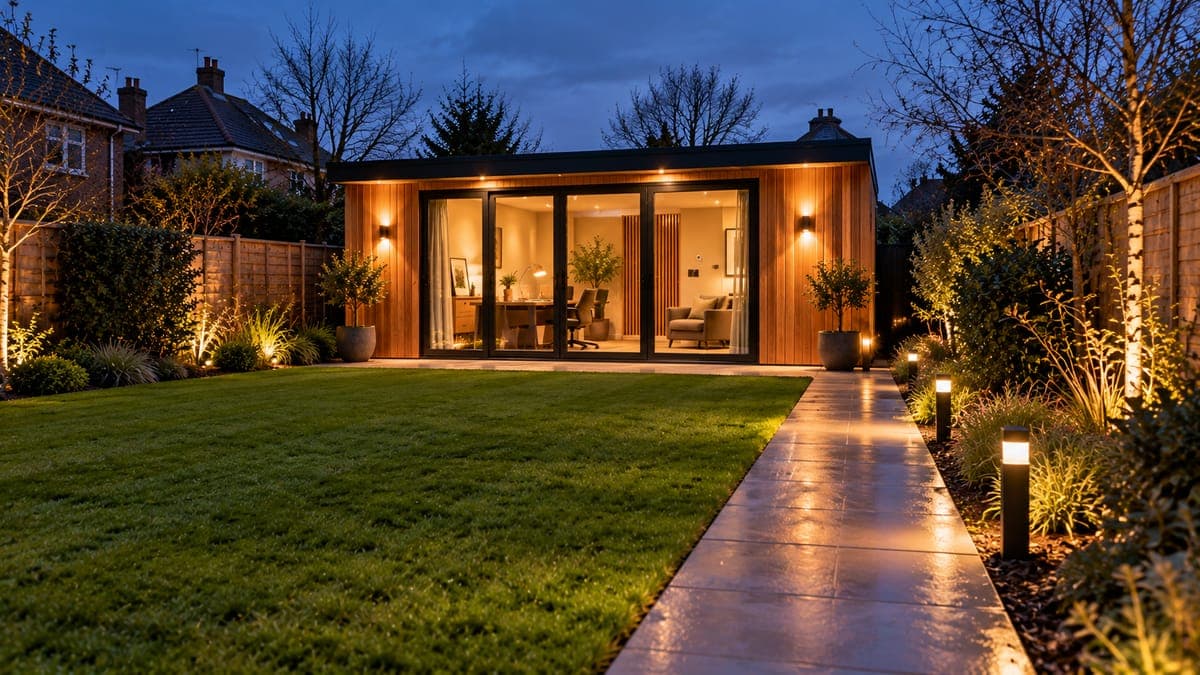
A garden room is only as useful as its power supply. Heating, lighting, a desk full of screens, a treadmill or a projector all depend on a cable that nobody sees once the job is finished. It is also the part of the build that people ask us about most before they order: where does the cable go, does the room get its own fuse board, can a handy relative do it, and what paperwork should there be at the end?
This guide explains how power gets from the house to the room, what is fitted inside, and what Irish law says about who may do the work. The legal points are checked against Safe Electric, the Commission for Regulation of Utilities and ESB Networks, and linked so you can read them yourself.
The short version
- A garden room is fed from the house, not from its own ESB connection. A dedicated cable runs from the house fuse board to a small consumer unit in the room.
- That cable is normally steel wire armoured and buried in a narrow trench, dug before the garden is finished.
- The work is Restricted Electrical Work, so only a Registered Electrical Contractor may do it. There is no exemption for doing it yourself.
- You should be handed a Safe Electric completion certificate when it is done.
Where the power comes from
A garden room in the back garden of a house does not get a separate electricity connection or a second meter. It is supplied from the house’s own distribution board, the fuse board usually found in the hall, utility room or under the stairs. The electrician adds a dedicated circuit there, with its own protective device, and that circuit feeds the room and nothing else.
The first thing the electrician looks at is the board itself: whether it has a spare way for the new circuit, whether it is in good enough condition to add to, and where the cable can leave the house. An older board sometimes needs work before anything can be added to it. That is worth knowing early, because it affects the quote, not the design of the room.
The cable: why it is armoured and buried
The cable between the house and the room is the one part of the installation that lives outdoors for decades, so it is not ordinary house wiring. The usual choice is steel wire armoured cable, often called SWA: the conductors are wrapped in a layer of steel wires under a tough outer sheath, which protects them from a garden fork, a fence post or a curious dog.
The neatest route is underground. A narrow trench is dug from the house to the room, the cable is laid, and the ground is put back. Where a trench would mean lifting a good patio, the cable can sometimes be fixed along a solid boundary wall instead. The size of the cable is the electrician’s calculation, based on what the room will run and how far it is from the house: a longer run needs a heavier cable to deliver the same power.
Two practical points save money and mess. First, the trench is dug before paving, lawn or planting is finished, which is one reason the route is agreed at the design stage of our build process. Second, the same trench can carry a duct for a data cable, and the water and waste pipes if you are planning a garden room with a bathroom, so the garden is only dug once.
Before any digging, it is worth knowing what is already in the ground. ESB Networks says it is vital to request maps of underground electricity cables before carrying out digging work, and provides them on request by email. Those maps show the network’s cables, not anything a previous owner buried for a shed or a pond pump, so tell us about any old garden wiring you know of.
The consumer unit in the room
At the room end, the cable arrives at a consumer unit, a small fuse board of the room’s own. It divides the supply into separate protected circuits, typically one each for sockets, lighting and heating. If a faulty appliance trips the sockets, the lights stay on, and you reset the switch in the room instead of crossing the garden in the dark.
Every room we build has one as part of its electrical package, alongside double sockets, LED spotlights inside and out, an electric radiator and a smoke alarm. The full list is on our specifications and quality pages.
Working out how much power you need
The supply is sized for what the room will run, so the most useful thing you can do before the site visit is make a list. Typical loads are:
- Heating. Usually the largest steady load in the room.
- Sockets. Computers and screens draw little; a kettle, a treadmill or a kiln draws a lot.
- Lighting. LED fittings inside and outside use very little.
- Anything with a heating element or a motor. An electric shower, a water heater, a sauna or air conditioning each needs to be allowed for, and some need a circuit of their own.
The electrician also has to look at the house as a whole, because the room shares the house’s connection to the network. ESB Networks describes a standard domestic connection as 12 kVA and an enhanced one as 16 kVA, and suggests considering the larger one where large heat pumps or a lot of storage heating are installed. A house that already runs electric showers, a heat pump and a car charger has less headroom than one with gas heating, so the loads are added up before the cable is sized, not after.
Who is allowed to do the work
This is the part that is law, not preference. Under regulations in force since 1 October 2013, Restricted Electrical Works in a domestic property can only be carried out, and must be certified, by a Registered Electrical Contractor. The restricted list includes installing or replacing circuits and installing, modifying or replacing a distribution board. Supplying a garden room involves both: a new circuit from the house and a new board in the room.
The regulator’s decision paper on the scope of restricted works states that there is no legal exemption for the owner or occupier. What remains open to anyone is minor work: replacing a switch or socket like for like, moving a light fitting on its existing circuit, or adding a socket to an existing circuit. A cable to a new building is not minor work.
Registered contractors are regulated through Safe Electric, the statutory scheme overseen by the Commission for Regulation of Utilities. You can check any electrician on the Safe Electric register before work starts. If you are comparing quotes for a garden room, ask each supplier who does the electrical connection and whether that person is registered.
The certificate you should be given
When the installation is finished and tested, the contractor issues a completion certificate. Safe Electric explains that the original copy goes to the customer, that a copy is returned to Safe Electric, and that customers should always ask for the certificate immediately after completion. It is the record that the work meets the National Rules for Electrical Installations.
Keep it with the deeds and other house documents. It is the simplest proof that the electrics in the room were installed properly, and it is the kind of document a surveyor or solicitor may look for if you sell. If a contractor refuses to provide one, Safe Electric has a complaints process for exactly that.
Does adding power affect planning?
No. Connecting electricity does not change how a garden room is treated for planning. What matters is its size, height, position and use: under S.I. No. 338 of 2026, garden rooms, sheds and similar structures are exempt up to a combined 30 m², provided the conditions are met and the room is not used for human habitation. A wired, heated room used as an office or gym is within that; a room someone lives in is not. Our planning permission guide covers the conditions.
What it costs
The electrical package inside the room is part of a turnkey price, not an extra. Most of our rooms in the 15 to 30 m² range start at roughly €32,000 to €50,000 plus VAT, finished and wired. What varies from garden to garden is the supply run: its length, what it has to pass under, and whether the house board needs work first. That is why it is priced after the site visit and set out in the written quote. Our garden room cost guide explains what is and is not included.
Frequently asked questions
- Can I wire a garden room myself?
- Not the supply or the circuits. In a home, installing a new circuit or fitting or altering a distribution board is Restricted Electrical Work, which by law only a Registered Electrical Contractor may carry out and certify. The regulator's decision is explicit that there is no exemption for the owner or occupier. Minor works, such as replacing a switch like for like or adding a socket to an existing circuit, are outside the restriction.
- Can I run a garden room off an extension lead?
- Not as a permanent arrangement. An extension lead is a temporary way to power a tool, not a supply for a room with heating, lighting and a desk full of equipment. A room that is used every day needs its own fixed supply from the house, installed and certified by a Registered Electrical Contractor.
- Does a garden room need its own fuse board?
- The rooms we build have one. A small consumer unit inside the room splits the supply into separate protected circuits for sockets, lighting and heating, so a fault in one does not take out the rest, and you can reset a tripped switch without walking back to the house.
- What certificate should I get for garden room electrics?
- A Safe Electric completion certificate. Safe Electric says the Registered Electrical Contractor issues the original copy to the customer, and that customers should ask for it immediately after the work is completed. It confirms the work was tested and meets the National Rules for Electrical Installations. Keep it with the house documents.
- Will I need to upgrade my ESB connection?
- Usually the electrician can answer this at survey stage. ESB Networks describes a standard domestic connection as 12 kVA and an enhanced one as 16 kVA. Whether a garden room fits within what you have depends on what else the house runs, such as electric showers, a heat pump or a car charger, so the contractor adds up the loads before the cable is sized.
- Is the cable buried or run along the fence?
- Either can be done, and the route is agreed on the site visit. A buried armoured cable is the usual choice because it is out of sight and out of harm's way. Where a trench would mean lifting a patio, the cable can sometimes be fixed along a solid wall instead. The electrician decides what the route and the wiring rules allow.
How Modern Garden Rooms helps
On the site visit we look at where the house fuse board is, how the cable can get from there to the room and what you plan to run in it. The route and the electrical layout, down to where the sockets and switches go, are agreed with the design, so there are no surprises when the trench is dug. The supply is installed by a Registered Electrical Contractor and you receive the completion certificate at handover.
The rules on restricted electrical works, completion certificates and connection capacity were checked against Safe Electric, the Commission for Regulation of Utilities and ESB Networks on 19 November 2026. This guide is general information, not electrical design advice for a specific property.
