
Irish homes are big by European standards and they are not always lived in the way their size suggests. The Census counts the rooms and bedrooms in every home, the CSO records the floor area of every new home granted planning permission, and Eurostat measures how many people live in homes that are too small or larger than they need. This page brings those sources together for journalists, researchers, planners and anyone thinking about how much space a household really uses. Each figure is labelled with the period it measures. The detailed room and bedroom figures come from the Census of April 2022, which remains the latest full count.
Key home size statistics for Ireland at a glance
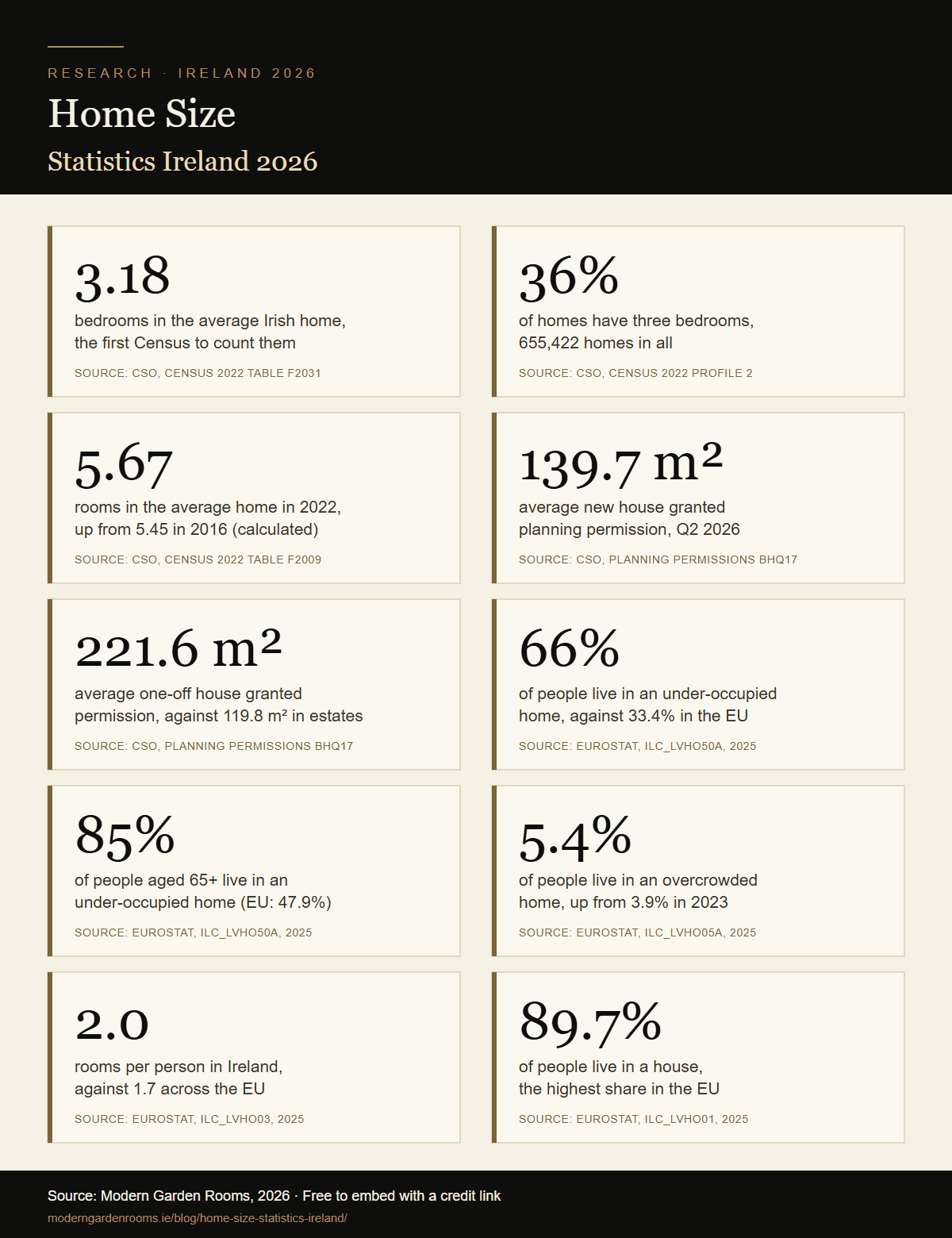
- The average Irish home had 3.18 bedrooms in 2022, the first time the Census asked about bedrooms. Source: CSO, Census 2022 table F2031.
- Three-bedroom homes were the most common, at 655,422, or 36% of occupied homes. Source: CSO, Census 2022 Profile 2.
- The average home had 5.67 rooms in 2022, up from 5.45 in 2016, calculated from the room counts. Source: CSO, Census 2022 table F2009.
- New houses granted planning permission in the second quarter of 2026 averaged 139.7 square metres, and new apartments 80.3 square metres. Source: CSO, Planning Permissions table BHQ17.
- One-off houses granted permission averaged 221.6 square metres, close to double a house in a housing development. Source: CSO, Planning Permissions Q2 2026.
- 66.0% of people in Ireland live in an under-occupied home, double the EU rate of 33.4% and the second highest in the EU. Source: Eurostat, ilc_lvho50a.
- Among people aged 65 and over, 85.0% live in an under-occupied home, against 47.9% across the EU. Source: Eurostat, ilc_lvho50a.
- 5.4% of people live in an overcrowded home, up from 3.9% in 2023 but far below the EU rate of 16.8%. Source: Eurostat, ilc_lvho05a.
- 58,869 homes had more than one person per room in 2022, and 9,271 had more than two. Source: CSO, Census 2022 Profile 2.
- 89.7% of people in Ireland live in a house, the highest share in the EU, against 51.5% across the EU. Source: Eurostat, ilc_lvho01.
Embed This Infographic
This infographic is free to use on your own site. Copy the code below and keep the credit link back to this page.
<a href="https://moderngardenrooms.ie/blog/home-size-statistics-ireland/"><img src="https://moderngardenrooms.ie/images/blog/home-size-statistics-ireland-infographic.png" alt="Home Size Statistics Ireland 2026 infographic by Modern Garden Rooms" width="1200" height="1560" style="max-width:100%;height:auto;border:0;" /></a>
<p>Source: <a href="https://moderngardenrooms.ie/blog/home-size-statistics-ireland/">Home Size Statistics Ireland 2026</a> by Modern Garden Rooms</p>
How many rooms and bedrooms Irish homes have
Census 2022 counted 1,836,728 occupied private dwellings. It was the first census to ask how many bedrooms each home had, and the answer was an average of 3.18 bedrooms per household. Three bedrooms is the standard Irish home. Over a third of occupied homes, 655,422, had three bedrooms, about a quarter had four, 16% had two, about 6% had one and 8% had five or more. The share of three-bedroom homes was highest in South Dublin at 48%, and Galway County had the highest shares of homes with four and five or more bedrooms.
The average number of bedrooms ran from 2.51 in Dublin City to 3.58 in Galway County, a gap of more than one bedroom per home between the most urban and one of the most rural local authority areas.
Room counts give a fuller picture, because the Census counts kitchens, living rooms, studies and conservatories you can sit in as well as bedrooms, and leaves out bathrooms, toilets, utility rooms and halls. Calculated from CSO table F2009, the average home had 5.67 rooms in 2022, up from 5.45 in 2016 and 5.52 in 2011. Five rooms was the most common size, at 437,291 homes or 24.6% of homes that stated a room count. Homes with four rooms or fewer fell from 29.0% of the total in 2016 to 24.1% in 2022, and the number of one-room homes fell from 23,752 to 8,640.
Detached houses, semi-ds and apartments compared
Home size follows home type closely. A detached house had an average of 6.62 rooms and 3.69 bedrooms in 2022, while a purpose-built apartment had 3.38 rooms and 1.96 bedrooms. More than half of detached houses, 51.9%, had seven rooms or more, a share calculated from the Census room counts.
| Type of home | Rooms | Bedrooms |
|---|---|---|
| Detached house | 6.62 | 3.69 |
| Semi-detached house | 5.74 | 3.25 |
| Terraced house | 5.04 | 2.84 |
| Purpose-built apartment | 3.38 | 1.96 |
| All homes | 5.67 | 3.18 |
Ireland is a country of houses. Calculated from CSO table F2008, 41.2% of occupied homes in 2022 were detached houses, 756,660 in all, and houses of every kind made up 86.9% of homes. Flats, apartments and bedsits made up the remaining 13.1%. Eurostat’s survey puts the share of people living in a house at 89.7%, the highest in the EU, with 50.6% in a semi-detached house, the second highest share after the Netherlands.
How big new homes are
The CSO records the floor area of every home granted planning permission. In the second quarter of 2026, new houses averaged 139.7 square metres and new apartments 80.3 square metres. The average hides a wide spread. A one-off house, typically a family building its own home on its own site, averaged 221.6 square metres, while a house in a multi-home development averaged 119.8 square metres. Of the 11,912 homes granted permission in the quarter, 53% were houses, and a further 2,148 permissions were granted for extensions.
New houses have grown over four decades. The annual figures in CSO table BHA14 show the average house granted permission rising from 113 square metres in 1984 to 142 square metres in 2025, and the average apartment from 66.3 to 81 square metres. In 2025, one-off houses averaged 225 square metres and houses in developments 114 square metres.
Apartment sizes are set by national rules. The Design Standards for Apartments issued on 8 July 2025 set minimum floor areas of 32 square metres for a studio, 45 for a one-bedroom apartment, 63 for a three-person two-bedroom apartment, 73 for a four-person two-bedroom apartment, 76 for a new four-person three-bedroom type and 90 for a five-person three-bedroom apartment. At least a quarter of the units in a scheme must exceed those minimums by 10%.
Older homes, newer homes and who lives in them
Most of the housing stock was built in the last forty years, but a large share is much older. Census 2022 counted 93,128 homes built in 2016 or later, 5.1% of the total. Calculated from CSO table F2006, 24.5% of homes were built between 2001 and 2010 and 8.4% before 1919. Apartments made up 15% of homes built since 2016, below the peak of more than 20% for homes built between 2001 and 2010.
Newer homes are fuller. Homes built since 2016 housed 3.13 people on average in 2022, while homes built before 1919 housed 2.29, both calculated from the same Census table. Newer homes are more often bought by younger families with children, and older homes are more often lived in by people whose children have left.
Household size in Ireland
Irish households are among the largest in Europe. The average private household had 2.74 people in 2022, against 2.75 in 2016 and 2.73 in 2011, so the long fall in household size seen elsewhere has stalled in Ireland. The average ran from 2.48 people in Dublin City to 3.02 in Fingal and Meath.
Eurostat’s survey measure, which differs slightly from the Census, puts the average Irish household at 2.7 people in 2025 against 2.3 across the EU, the third highest after Slovakia and Poland. The ESRI found that Ireland has had the highest average household size of 16 western European countries since 2011. The same paper notes that among households headed by someone under 40, just 11% in Ireland are single adults with no children, against 40% in other western European countries.
Spare rooms: under-occupied homes
Eurostat counts a home as under-occupied when it has more rooms than its household needs under a standard that allows one room for the household, one for each couple, one for each single person aged 18 or over, and shared rooms for children depending on their age and sex. On that measure, 66.0% of people in Ireland lived in an under-occupied home in 2025, against 33.4% across the EU. That is the second highest rate in the EU after Cyprus, and close to double the EU rate.
The gap is widest for older people. 85.0% of people aged 65 and over in Ireland live in an under-occupied home, against 47.9% across the EU, the third highest rate after Cyprus and Malta. Ireland had the highest rate in the EU in 2022 and 2023, at 88.3% and 88.9%. Irish homes also have more space per person overall, with 2.0 rooms per person against 1.7 in the EU, rising to 2.2 rooms per person for owner-occupiers. Tenants have 1.5 rooms per person, the same as the EU average.
Older people rarely move. An ESRI study of people aged 50 and over found that only 3.1% moved house between the survey waves of 2009 to 2011 and 2012, and that 40.6% of those living alone were in homes of four rooms or fewer. That study uses data now more than ten years old and is the most recent ESRI work on the question.
Overcrowded homes
Overcrowding is rare in Ireland by European standards, but it is rising. Eurostat counts a home as overcrowded when it has fewer rooms than the same standard requires. 5.4% of people in Ireland lived in an overcrowded home in 2025, up from 3.9% in 2023 and 5.0% in 2024. The EU rate was 16.8%, and only Malta, the Netherlands and Cyprus had lower rates. Children are most affected. The overcrowding rate for under-18s in Ireland rose from 6.3% in 2023 to 9.7% in 2025, against 25.3% across the EU, while for people aged 65 and over it was 1.2%.
The Census measures crowding by persons per room. In 2022, 58,869 homes had more than one person per room, 3.2% of households, and 9,271 had more than two. At the other end, 860,015 homes, or 46.8%, had fewer than 0.5 persons per room, which means at least two rooms for every person living there. Both shares are calculated from the Census table.
| Measure | Ireland | EU-27 | Ireland’s rank |
|---|---|---|---|
| People in an under-occupied home | 66.0% | 33.4% | 2nd highest |
| People aged 65+ in an under-occupied home | 85.0% | 47.9% | 3rd highest |
| People in an overcrowded home | 5.4% | 16.8% | 4th lowest |
| Average rooms per person | 2.0 | 1.7 | Joint 5th highest |
| Average household size | 2.7 | 2.3 | 3rd highest |
| People living in a house | 89.7% | 51.5% | Highest |
How much you can add without planning permission
Since 27 July 2026, homeowners can add more space without planning permission than before. S.I. No. 338 of 2026 raised the limit for garden rooms, sheds and home offices from 25 to 30 square metres in total, and the limit for a rear extension to a house that has not been extended before from 40 to 45 square metres. S.I. No. 340 of 2026 created a new exemption, Class 3A, for a detached home of between 32 and 45 square metres in the rear garden of a house, which must be occupied together with the main house and cannot be sold separately. A Class 3A home must be started and finished between 16 July 2026 and 31 December 2030. Our planning permission statistics for Ireland cover the wider planning system.
How these statistics were compiled
This page draws on the CSO’s Census 2022 Profile 2 and Summary Results releases and its tables F2003, F2004, F2006, F2008, F2009 and F2031, the CSO’s Planning Permissions release for the second quarter of 2026 and its tables BHQ17 and BHA14, Eurostat’s EU-SILC tables ilc_lvho50a, ilc_lvho05a, ilc_lvho03, ilc_lvph01 and ilc_lvho01, two ESRI publications, the Department of Housing’s apartment design standards and the Irish Statute Book. Every source was opened and every figure checked on 25 November 2026.
Figures described as calculated were worked out from the cited source and are not published by it: the average number of rooms (homes with ten or more rooms counted as ten and homes that did not state a count left out, so the averages are slightly low), the shares of homes by room count, by type and by year built, the persons per home by year built, the shares of homes by persons per room, and Ireland’s rank in the EU on each Eurostat measure. The Census and Eurostat measure household size differently, which is why the Census gives 2.74 people and Eurostat 2.7.
The page will be updated when the CSO publishes Planning Permissions for the third quarter of 2026, expected in December 2026, and the annual figures for 2026, expected in March 2027, when Eurostat publishes EU-SILC 2026 data during 2027, and when Census 2027 housing results appear. The year in the title identifies when the page was last compiled. It does not mean every statistic was measured in 2026.
How Modern Garden Rooms helps
The figures above show that most Irish homes have rooms to spare on paper and still fall short in practice. A spare bedroom does not make a quiet office, and a large house with grown-up children still at home, or a parent who needs their own front door, can feel crowded. Adding a room in the garden is often simpler than moving, and since July 2026 more of it can be done without planning permission.
Modern Garden Rooms designs and builds insulated garden offices and garden rooms of up to 30 square metres, and granny flats of 32 to 45 square metres under the new Class 3A exemption, across Dublin and the surrounding counties. Our garden room cost guide sets out prices by size, and a free site visit will confirm what your garden allows.
