
Ireland has never had an official count of short-term lets, which is why the figures quoted in the housing debate range from 8,600 to nearly 29,000 depending on who counted and how. That changes on 1 December 2026, when a national register opens. This page sets out the current estimates side by side, explains what each one measures, compares them with the number of homes available to rent, summarises the new rules and the tax position, and adds the CSO figures on the millions of visitors who stay with family and friends rather than in paid accommodation. Each figure is labelled with its source and date.
Key short-term letting statistics for Ireland at a glance
- A draft report for the Housing Agency counted 28,903 short-term lets available in Ireland, 9,186 of them in Dublin. Source: Housing Agency draft report, as reported by RTÉ, June 2026.
- Threshold found 20,039 entire properties listed for short-term letting against 2,100 full-time private rentals, or 8,600 against 2,100 when hosts with a single listing are excluded. Source: Threshold analysis, as reported by the Irish Examiner, March 2026.
- In Kerry there were 31 short-term lets for every home available to rent, 1,009 against 33. Source: Threshold analysis, as reported by the Irish Examiner, March 2026.
- There were just under 2,400 homes available to rent nationwide on 1 August 2026, compared with a pre-pandemic norm of over 4,300. Source: Daft.ie Rental Report Q2 2026, as reported by RTÉ.
- Two-thirds of Airbnb listings are entire properties, and 38 of the 166 local electoral areas have at least one Airbnb for every 10 private rental homes. Source: ESRI, April 2025.
- The Short Term Letting and Tourism Bill creates a register run by Fáilte Ireland covering stays of up to 21 nights, opening on 1 December 2026. Source: Department of Enterprise, Tourism and Employment, 6 October 2026.
- Platforms that seriously breach the new rules face fines of up to 2% of annual worldwide turnover. Source: Department of Enterprise, Tourism and Employment, 6 October 2026.
- Rent-a-Room Relief does not apply to letting periods of 28 consecutive days or less, or to short-term guests booked through online platforms. Source: Revenue, Rent-a-Room Relief conditions, January 2026.
- 33% of overseas visitors in August 2026 came to visit friends and relatives, out of 788,700 visitors that month. Source: CSO, Inbound Tourism August 2026.
- 40% of domestic overnight nights in the second quarter of 2026 were spent with friends or relatives, more than in hotels at 34%. Source: CSO, Household Travel Survey Q2 2026.
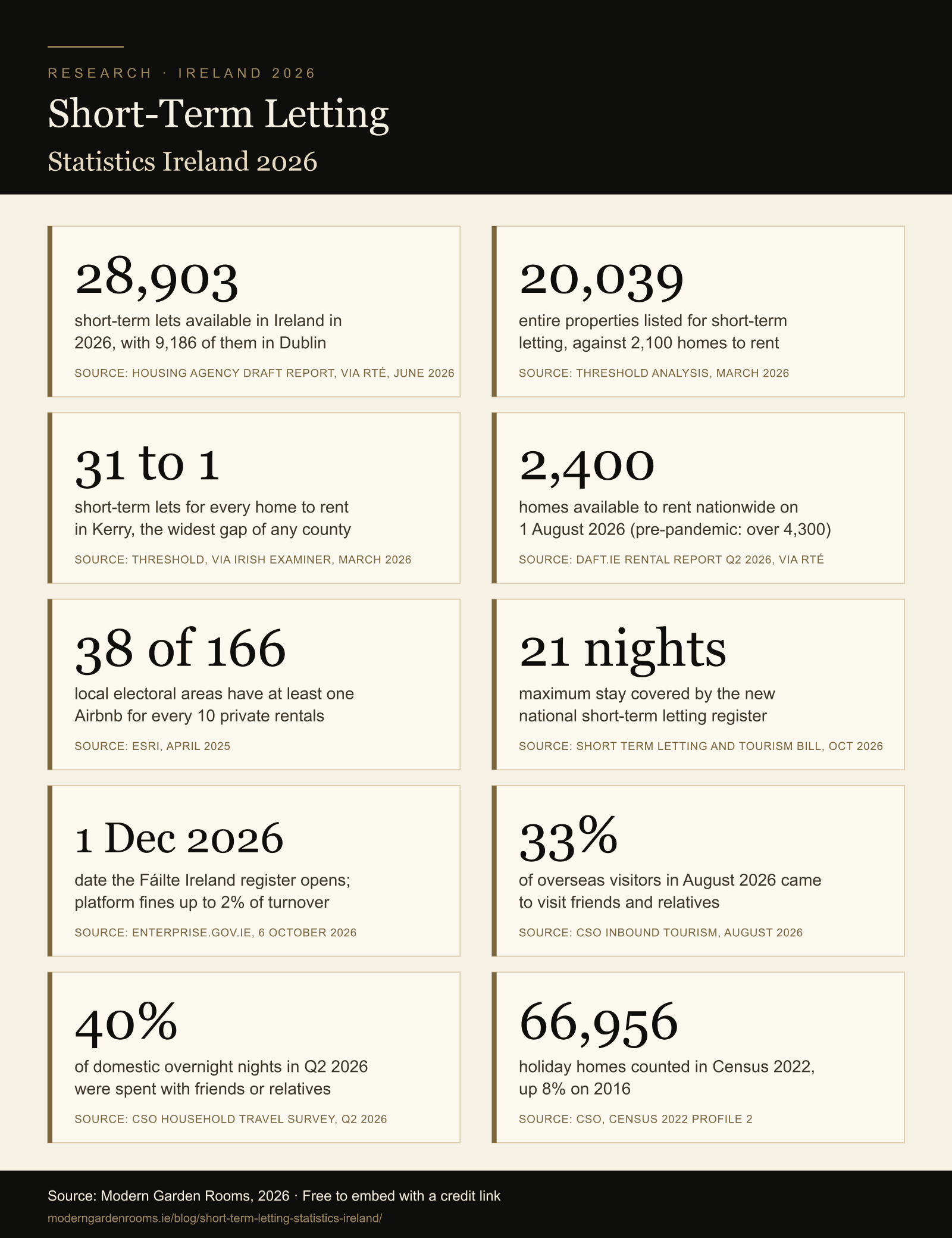
Embed This Infographic
This infographic is free to use on your own site. Copy the code below and keep the credit link back to this page.
<a href="https://moderngardenrooms.ie/blog/short-term-letting-statistics-ireland/"><img src="https://moderngardenrooms.ie/images/blog/short-term-letting-statistics-ireland-infographic.png" alt="Short-Term Letting Statistics Ireland 2026 infographic by Modern Garden Rooms" width="1200" height="1560" style="max-width:100%;height:auto;border:0;" /></a>
<p>Source: <a href="https://moderngardenrooms.ie/blog/short-term-letting-statistics-ireland/">Short-Term Letting Statistics Ireland 2026</a> by Modern Garden Rooms</p>
How many short-term lets Ireland has
The widest count is the one prepared for the State. A draft report commissioned by the Housing Agency, using Airbnb data as a proxy, found 28,903 short-term lets currently available in Ireland, as reported by RTÉ in June 2026. Dublin accounted for 9,186 of them, or 32%, and the cities together for about 40% of the national total. The Department of Housing estimated that up to 12,000 properties could return to the long-term market under the new rules. The report was a draft at the time, and its final figures may differ.
The tenants’ charity Threshold counts differently, using Inside Airbnb scrapes of listings. Its March 2026 analysis, reported by the Irish Examiner, found 20,039 properties available for short-term letting including hosts with a single listing, and 8,600 once those single-listing hosts were excluded. A year earlier, Threshold had counted 20,176 entire properties on a single date in December 2024, of which almost 8,000 were run by hosts with more than one property.
The ESRI, in research published in April 2025, found that two-thirds of Airbnb listings are for entire properties, with 9,142 entire-property listings inside Rent Pressure Zones in September 2023. Listings are concentrated in tourist areas along the west coast and in inner-city Dublin and Galway. The ESRI also warned that without a comprehensive register it is not possible to say how much of all short-term letting Airbnb represents. The three counts differ because they include or exclude private rooms, single-listing hosts and other platforms, and they were taken on different dates.
Short-term lets compared with homes to rent
The comparison that drives the debate is with the long-term rental market. Daft.ie counted just under 2,400 homes available to rent nationwide on 1 August 2026, up 5% on a year earlier but far below the pre-pandemic norm of over 4,300 at any one time. Dublin availability fell 18% in the year to below 1,150 homes, while the rest of the country rose by 40%. Set against the Housing Agency count of 28,903 short-term lets, that is about 12 short-term lets for every home to rent, a ratio calculated from two sources with different dates and definitions.
Threshold’s own comparison uses 2,100 full-time private rentals. On its conservative count of 8,600 lets, there were at least four short-term lets for every home to rent in March 2026, and nearly ten times as many on the full count of 20,039. The gaps are widest in tourist counties.
| Area | Short-term lets | Homes to rent | Ratio |
|---|---|---|---|
| Kerry | 1,009 | 33 | 31 to 1 |
| Clare | 532 | 19 | 28 to 1 |
| Donegal | not stated | not stated | 24 to 1 |
| Mayo | not stated | not stated | 14 to 1 |
| Leitrim | not stated | not stated | 12 to 1 |
| Cork city and county | not stated | not stated | 3.7 to 1 |
| Ireland (multi-listing hosts only) | 8,600 | 2,100 | 4 to 1 |
Source: Threshold analysis, as reported by the Irish Examiner, 13 March 2026. The county ratios exclude hosts with a single listing.
Threshold has since updated its city figures. Using Inside Airbnb data gathered in June 2026 and Daft.ie data from October 2026, it reports 1,997 entire properties in Dublin operated by hosts with more than one property, against 1,263 homes to rent in all of Dublin. In Galway city and county there were 1,249 such listings against 218 homes to rent, in Cork 701 against 365, and in Limerick 117 against 73. The Dublin figure counts hosts with more than one property, while the other cities count hosts with more than two, so the four are not strictly comparable.
Who the hosts are
Airbnb’s own account of its Irish hosts is very different from the charity’s. Responding to Threshold in March 2025, the company said that a typical host in Ireland shares one home for less than four nights a month and nearly nine in ten entire-home hosts share only one listing, as reported by the Irish Times. In July 2024 Airbnb said the average Irish host earns more than €5,600 a year, a median figure from 2021, that hosts typically share their primary home for three nights a month, and that guest spending exceeded €500 million in 2022 and supported almost 5,000 jobs.
Both pictures can be true at once. Most hosts may list one home for a few nights a month while a minority of multi-property hosts account for a large share of the entire homes on offer. Threshold counted 856 Dublin hosts with 2,287 properties between them in December 2024, 292 Galway hosts with 1,009 properties and 312 Cork hosts with 616, according to its March 2025 release.
Do short-term lets cause the rental shortage
The evidence is more cautious than the headlines. The ESRI examined new tenancy registrations between 2019 and 2023 and found no evidence linking increases in short-term let activity to falls in new tenancy registrations. It concluded that short-term lets are not the primary cause of falling new rental commencements nationally, while local effects may still occur. It did find at least one Airbnb for every 10 private rental properties in 38 of the 166 local electoral areas, and that listings in rural tourist areas correlate strongly with previously recorded holiday homes.
The existing planning rules have barely been used. Since 2019, letting an entire home in a Rent Pressure Zone for more than 90 days a year has required planning permission for change of use. The ESRI reports that applications under those rules numbered just 91 in 2023, and Threshold counted 167 change-of-use requests across the 26 counties in 2024.
The new rules: a register from 1 December 2026
The Government published the Short Term Letting and Tourism Bill on 6 October 2026. It designates Fáilte Ireland as the competent authority and creates a national register of short-term lettings covering stays of up to 21 nights, giving effect to EU Regulation 2024/1028. The register opens on 1 December 2026. Hosts must obtain a registration number and display it on every advertisement and listing. Platforms must display those numbers, carry out random checks, submit data on short-term rental activity and remove non-compliant listings.
Enforcement runs from fixed payment notices and summary offences up to an administrative sanctions regime. For serious breaches by platforms, a panel of adjudication officers can impose fines of up to 2% of annual worldwide turnover. Every host must confirm that they are planning compliant in order to register, and hosts in places with a population under 20,000 have two years to regularise their planning. The Minister for Housing is to publish a National Planning Statement setting out the planning rules for the sector, which the Government had earlier agreed would restrict new short-term lets in towns of over 20,000 people, according to RTÉ’s June 2026 report. The EU regulation had required the register to be in place by 20 May 2026, so Ireland is late, and the Bill still has to pass the Oireachtas. The Irish Times report on the Bill notes that no registration fee had been announced at publication.
The same rules reach garden buildings. A detached garden home built under the 2026 planning exemption may not be used for short-term letting, and our planning permission statistics for Ireland set out the other conditions attached to it.
The tax position
Short-term letting income does not qualify for Rent-a-Room Relief. Revenue’s conditions state that the relief does not apply to income from letting periods which do not exceed 28 consecutive days, and that income from short-term guests, including those who book through online booking sites, is excluded. The exemption limit for 2026 is €14,000, and income from a host’s own child is also excluded. Budget 2027 proposed extending the relief to garden homes and raising the limit to €16,000 from January 2027, subject to the Finance Bill, but the 28-day exclusion remains, so a guest room let by the night is taxed as ordinary income.
Visiting friends and relatives: the unpaid half of tourism
A large share of Ireland’s visitors stay in somebody’s spare room rather than in paid accommodation. The CSO found that 33% of the 788,700 overseas visitors who completed a trip in August 2026 came to visit friends and relatives, compared with 51% on holiday and 8% on business. That is roughly 260,000 people in one month, calculated from the CSO figures. Visitors stayed an average of 8.3 nights, and overnight visits for the year to August reached 4.7 million, up 11% on 2025. The CSO treats nights spent with friends or relatives as unpaid accommodation, so they appear in the visitor count but not in the €729 million spent that month.
Irish residents do the same at home. In the second quarter of 2026 they spent 9.2 million nights on domestic trips, and 40% of those nights were with friends or relatives, ahead of hotels at 34%. Visiting friends and relatives was the purpose of 36% of domestic overnight trips, second only to holidays at 48%. The 40% share works out at about 3.7 million nights in a single quarter, calculated from the CSO total.
Holiday homes and empty homes
The Census provides the only full count of second homes. In April 2022 there were 66,956 holiday homes, up 8% from 62,148 in 2016, within a housing stock of 2,112,121 dwellings. The number of vacant dwellings fell by 11% to 163,433 over the same period. The ESRI’s finding that rural Airbnb listings track previously recorded holiday homes suggests that much of the short-term let stock outside the cities was never part of the long-term rental market. The next Census, in April 2027, will update these figures.
How these statistics were compiled
This page draws on the Department of Enterprise, Tourism and Employment, the ESRI, Threshold, the CSO, Revenue, the Irish Statute Book and Airbnb, with the Housing Agency, Daft.ie and Threshold’s 2026 county figures taken from RTÉ, Irish Times and Irish Examiner reports that name their source. Every source was opened and every figure checked on 20 October 2026. Figures described as calculated were worked out from the cited sources and are not published by them: the ratio of Housing Agency lets to Daft.ie rentals, the number of August visitors who came to see friends and relatives, and the number of domestic nights spent with friends or relatives.
Two limitations apply. The Housing Agency figure comes from a draft report that had not been published at the time of writing, and all of the listing counts rely on scraped Airbnb data rather than a register, so they omit other platforms and may count the same property more than once. The register itself will produce the first official figures during 2027.
The page will be updated when the register opens on 1 December 2026 and when Fáilte Ireland publishes registration numbers, when Daft.ie publishes its next rental report, and when Census 2027 reports holiday homes. The year in the title identifies when the page was last compiled. It does not mean every statistic was measured in 2026.
How Modern Garden Rooms helps
The visitor figures tell a simple story. Hundreds of thousands of people come to Ireland every month to stay with family, and two in five domestic overnight stays are in a friend’s or relative’s home. Most of those guests sleep on a sofa bed or in a child’s room, and the short-term letting rules do not touch them, because nobody is paying.
Modern Garden Rooms designs and builds insulated garden guest rooms across Dublin and Leinster, with en-suite and kitchenette options that give visitors a private space and give you your house back. They are built for hosting your own guests. Anyone who intends to let any accommodation by the night will need planning compliance and a Fáilte Ireland registration number from December, and our planning permission guide explains which garden buildings are exempt and on what conditions.
